
Search Is No Longer Where Travel Begins
For years, travel marketing followed a familiar playbook. Rank on Google, capture intent, convert the user. It worked and to some extent, it still does.
But something has shifted.
Travel discovery no longer starts with a search bar. It starts with a scroll.
A quick Reel of a hidden café in Himachal, a YouTube vlog walking through Bali or a TikTok showing a sunrise in Spiti, these moments don’t just inform, they create desire. And that desire often comes before any search happens.
The result? The entire travel marketing funnel has quietly rearranged itself.
The Old Travel Marketing Funnel
Not too long ago, the journey looked like this:
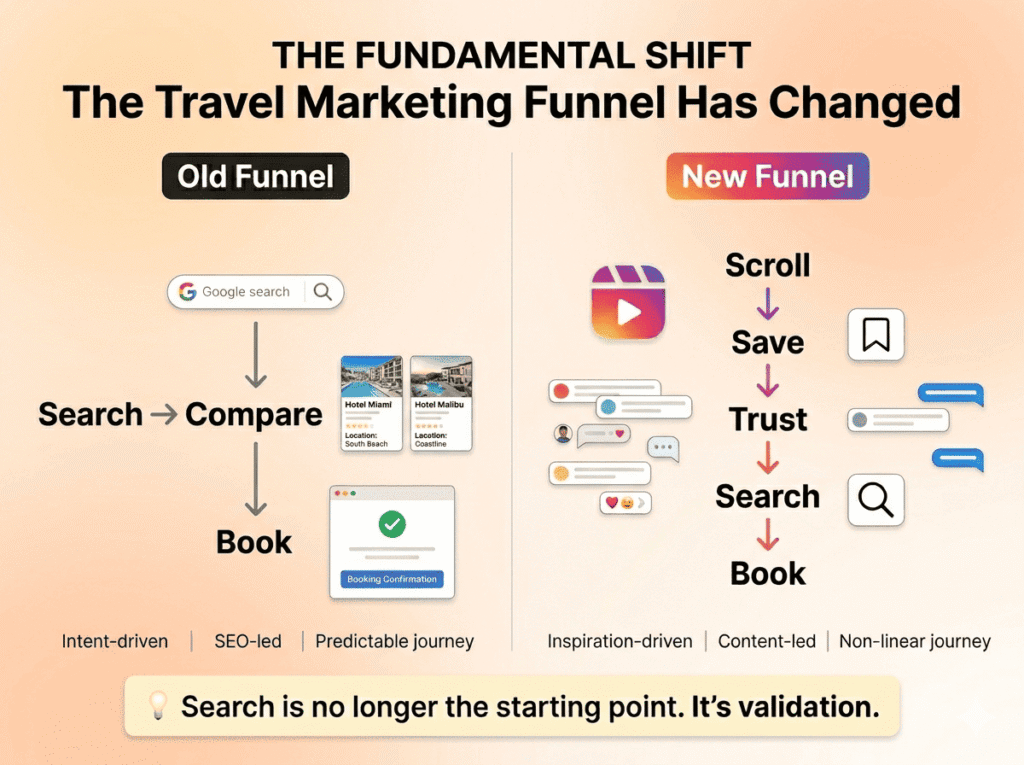
Search → Compare → Book
A user had intent. They searched for “best places to visit in Kerala” or “hotels in Manali.” Brands competed for visibility and the top results won attention.
It was structured, predictable and heavily dependent on SEO.
But this model assumed something important that the user already knew what they were looking for. That assumption no longer holds true.
The New Travel Discovery Funnel
Today, the journey looks more like this:
Scroll → Save → Trust → Search → Book
The shift is subtle but significant.
People don’t begin with intent anymore. They begin with exposure. A video appears, a destination looks interesting and the post gets saved, shared and revisited.
Only after that does search come into play. By the time someone searches, the decision is already half-made.
This is where travel marketing is changing the most, not at the point of conversion but at the point of discovery.
Why This Shift Happened
Several forces are driving this change and they’re all happening at once.
1. The Rise of Short-Form Video
Platforms like Instagram and TikTok have changed how content is consumed. Travel, being visual by nature, fits perfectly into this format.
A 30-second video can do what a 2,000-word blog sometimes can’t, it can make someone feel a place instantly.
In fact, studies suggest that over 60% of travellers now use social media for travel inspiration and that number continues to grow.
2. Visual-First Consumption
People don’t want to read about destinations first. They want to see them.
Waterfalls, cafés, mountain views, beaches, these are decisions driven by visuals, not text.
Search, by design, is text-first, while social is visual-first. That difference matters more than it used to.
3. Trust Has Shifted
Travel decisions are increasingly influenced by people, not brands.
Creators, vloggers and even random travellers documenting their trips often build more trust than polished campaigns.
Around 70% of travellers say social content influences their destination choices, not advertisements, not landing pages, but content.
4. Travel Has Become Experience-Led
Travel is no longer just about going somewhere. It’s about experiencing something.
And experiences are hard to explain through static content. They’re easier to show through video, storytelling and real moments, exactly what social platforms enable.
What This Means for Marketing in Travel
This shift doesn’t mean SEO is irrelevant. It just means it’s no longer the starting point.
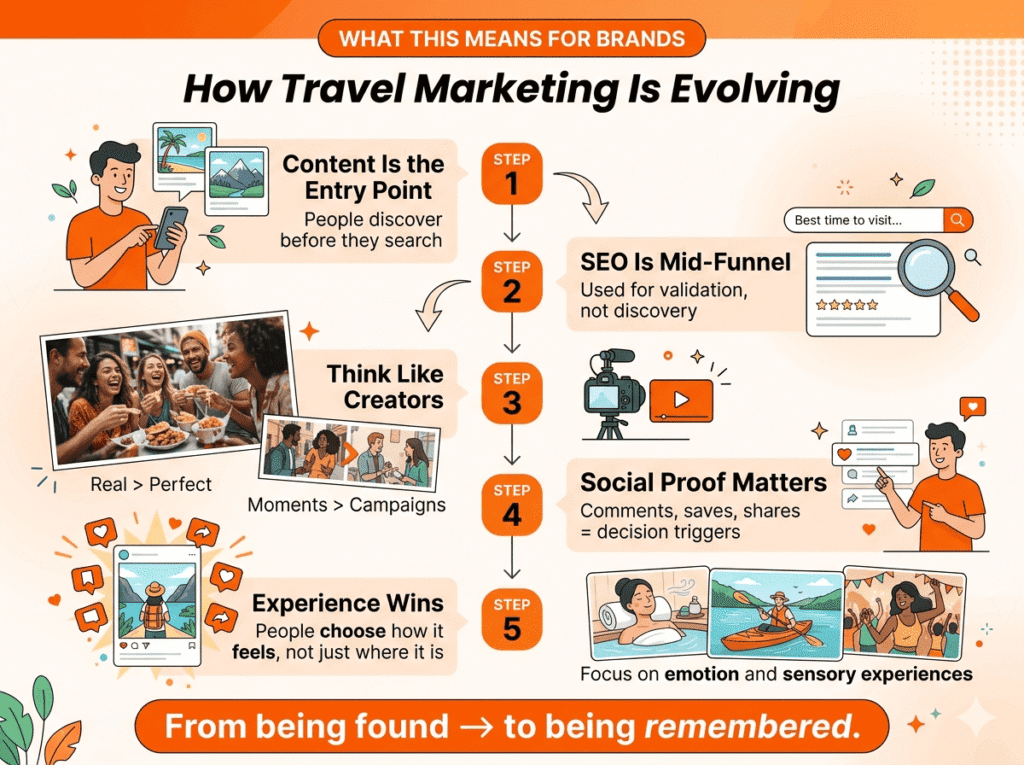
SEO Is Now Mid-Funnel
Search still matters, but it comes later.
Users search after they’ve already seen something after curiosity is built and interest is formed. SEO is now about capturing validation, not just discovery.
Content Is the New Entry Point
If discovery starts on social then content becomes the first interaction a user has with a brand or destination.
This changes how travel brands need to think. You’re no longer just optimizing pages. You’re creating moments.
Brands Need to Think Like Creators
The best-performing travel content today doesn’t feel like marketing. It feels like someone sharing a moment.
Unfiltered clips, real reactions, imperfect visuals, these build more trust than highly produced campaigns.
Authenticity > Production
There’s a noticeable shift away from perfection.
A slightly shaky phone video can outperform a professionally shot campaign, simply because it feels more real.
And in travel, “real” matters.
The Role of Social Proof
One of the most underrated parts of this shift is what happens after the content is posted.
People don’t just watch, they read comments, check engagement and look at what others are saying.
- “Is it actually worth it?”
- “How crowded is this place?”
- “Is this as good as it looks?”
These micro-interactions build trust.
Saved posts become future travel plans, shared videos turn into group discussions and DMs become informal recommendations.
This layer of social proof didn’t exist in traditional SEO. Now, it’s central to how decisions are made.
A Perspective from Within the Industry
As a platform building in travel tech, Solis Nature has observed this shift quite closely.
Users are increasingly arriving not because they searched for a destination, but because they discovered it somewhere else first like a reel, a video or a shared post. By the time they reach a platform, they’re not exploring anymore. They’re validating.
This is where an experience-led approach starts to matter more. Solis Nature isn’t just built around listings or locations but around how people actually want to travel today, slower, more intentional and closer to nature. The focus shifts from just “where to stay” to “how the place will feel.”
This changes how platforms think about visibility, content and even user intent. It’s less about being found and more about being remembered, not just as a destination but as an experience someone already connects with before they even begin to search.
The Future of Travel Marketing
Looking ahead, this shift is only going to deepen.
● Creator-Led Ecosystems
Creators will continue to shape travel decisions, not just through influence but through storytelling. Destinations will trend before they rank.
● Visual Search Will Rise
Search itself is evolving. People are already using screenshots, saved posts and visual references to explore places. The gap between “seeing” and “searching” is narrowing.
● Community Will Drive Decisions
Travel is becoming more community-driven. People trust what others have experienced and not what brands claim.
● Content Will Lead the Funnel
Marketing in travel will increasingly start with content, not campaigns. The brands that understand this early will have a significant advantage.
Closing Thought
The biggest change in travel marketing isn’t the platform. It’s the starting point.
Discovery used to begin with intent. Now, it begins with inspiration and that changes everything. Because the future of travel marketing isn’t about ranking first.
It’s about being remembered before the search even happens.
And that’s where platforms like Solis Nature quietly fit in. Not by trying to capture attention at the moment of search but by understanding how travellers are already discovering places through moments, visuals and stories that stay with them.
Because in the end, travel decisions aren’t always logical. They’re felt first. Then searched.