Real Performance Marketing: Better Tracking, Better Growth
Most people call themselves “performance marketers” because they run ads.
But running ads is not performance marketing.
Performance marketing starts when you can answer these questions with confidence:
- What actions are users taking on my website/app?
- Which actions are true buying signals (not vanity engagement)?
- Which campaigns are driving qualified outcomes (not cheap noise)?
- Can I measure results consistently across platforms and analytics?
In the AI era, this matters even more—because Google and Meta are learning systems. They learn from the signals you feed them. If your tracking is weak or your events are messy, platforms learn the wrong patterns, optimization becomes unreliable, and scaling becomes expensive guesswork.
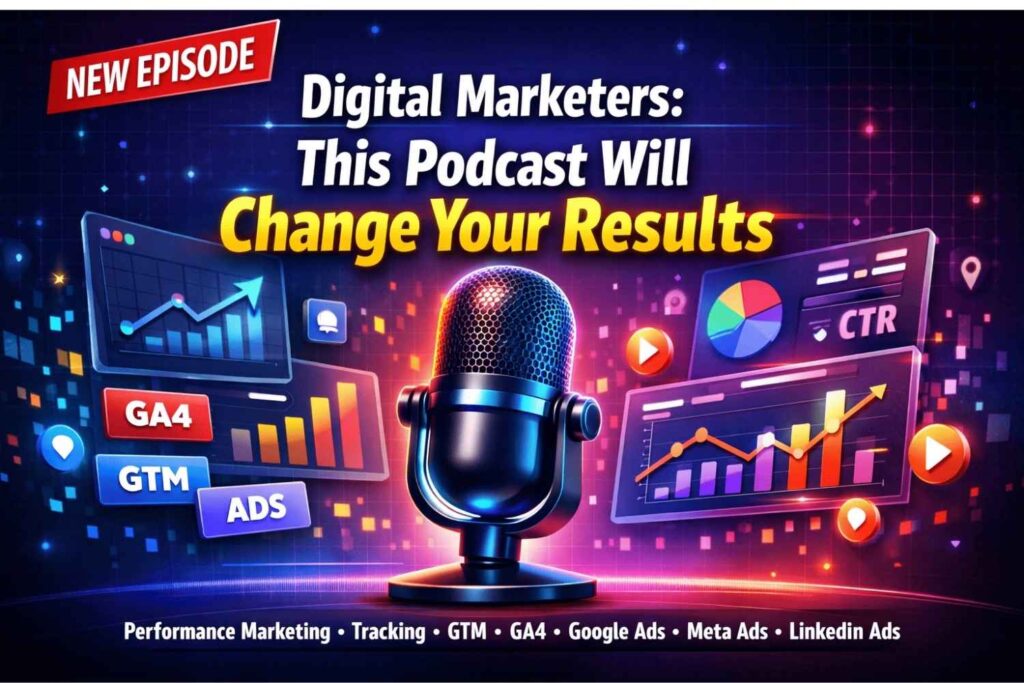
That’s why this podcast episode is built around one clear message:
Better Tracking → Better Measurement → Better Growth
Watch the Full Episode (YouTube)
What You’ll Learn in This Episode
1) Why “running ads” is not performance marketing
If measurement is unclear, “optimization” is just guessing.
A campaign can show conversions in an ad platform while the business sees no revenue impact—because the tracking and conversion definitions are wrong.
2) Why first-party data is now a growth advantage
Third-party data is depreciating fast. The most valuable signals are now:
- What users do on your owned assets (website/app)
- the events you track
- The conversion quality you send back to platforms
If you don’t track meaningful actions, the platforms can’t learn what “good” looks like.
3) The Track → Measure → Scale mindset
This is the simplest way to think like a real performance marketer:
Track: set the right events and conversions
Measure: validate data, map actions to business outcomes
Scale: increase budgets only when data is clean and results are predictable
What “Better Tracking” Actually Means (Practical, Not Buzzwords)
Better tracking is not “track everything.”
It means tracking the right actions and sending clean signals.
Here are examples of high-signal events most businesses should consider:
- Lead form submit (not just page views)
- Call click / WhatsApp click
- View key pages (pricing, product, case studies)
- Add to cart / begin checkout / purchase (for e-commerce)
- Signup / trial started / demo booked (for SaaS and B2B)
Then comes the important part:
- naming events properly
- keeping parameters consistent
- avoiding duplicates
- validating in GA4 / GTM preview / platform event managers
Common Reasons Performance Breaks (And People Blame “The Algorithm”)
1) Wrong primary conversions
If you optimize on shallow events (clicks, page views), you’ll attract shallow traffic.
2) Lead quantity without lead quality
You can get “leads” all day and still fail commercially if your funnel doesn’t qualify and your feedback loop doesn’t exist.
3) Platform vs GA4 mismatch confusion
Different attribution windows and tracking setups can make numbers look inconsistent. The fix is not panic—it’s a reconciliation method and clean tagging.
4) Weak funnel experience
If landing pages, offer clarity, and response speed are poor, tracking won’t save you. Tracking reveals problems; it doesn’t magically convert users.
Who This Episode Is For
This is for you if:
- you’re spending on Google/Meta/LinkedIn but outcomes are inconsistent
- you’re a marketer who wants to move beyond “running campaigns”
- you want to become valuable in the AI era by mastering measurement
- you’re tired of vanity metrics and want business-level reporting
Next Step (If You Want the Implementation Blueprint)
If you want a simple structure to implement this properly, I can share a First-Party Tracking & Event Map template you can use to plan:
- what to track
- where to track it
- what is primary vs micro conversion
- what to send to each ad platform