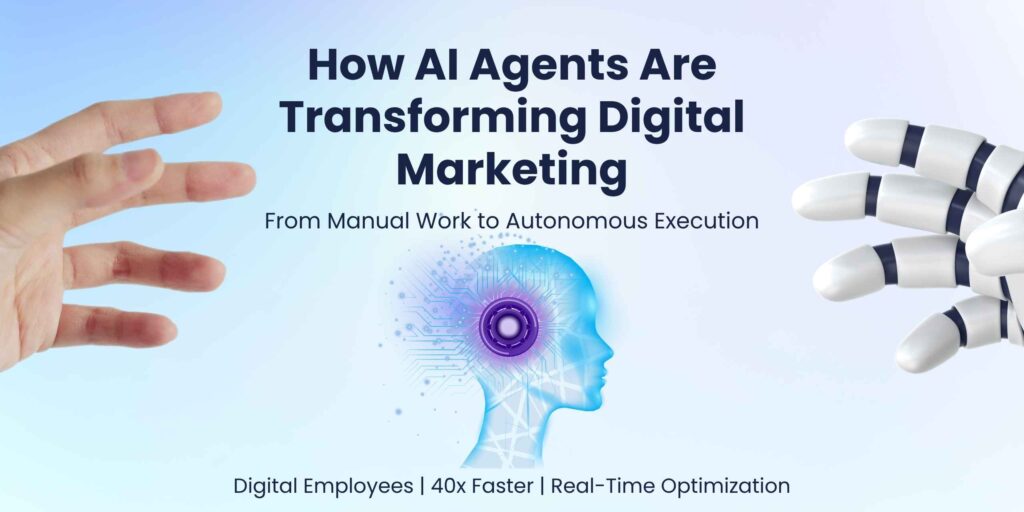
In the early 2020s, digital marketing was defined by automation—the execution of pre-set “if-this-then-that” rules. By 2026, the industry has crossed the rubicon into the era of Agentic Workflows. We are no longer simply using tools; we are managing “Digital Employees”—autonomous systems capable of reasoning, planning, and executing complex lifecycles with minimal human intervention.
This article explores the transformation of the marketing stack, the shift in productivity benchmarks, and the emergence of the new “Share of Model” economy.
1. From Assistance to Autonomy: Defining the AI Agent
In 2026, the distinction between a “tool” and an “agent” is clear:
- AI Tools (2023-2024): Required a human to prompt, verify, and move data between platforms.
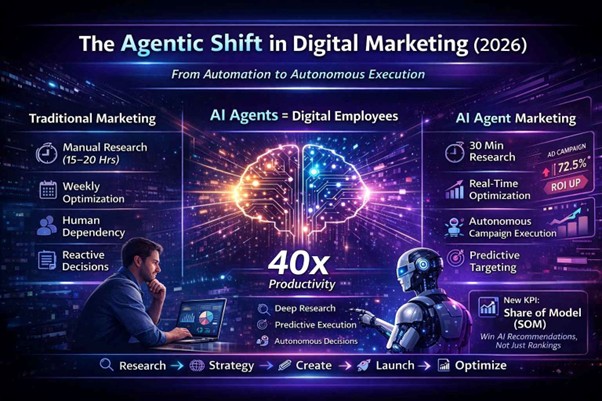
- AI Agents (2026): Act independently. They identify a market gap, conduct deep research, generate the creative assets, deploy the campaign, and reallocate budget in real-time based on live conversion data.
The workflow has shifted from Reactive Marketing (adjusting after seeing a report) to Predictive Execution (adjusting before the trend peaks).
2. The Deep Research Revolution
The most significant productivity leap has occurred in the strategy phase. The “Deep Research” capabilities of models like Gemini and OpenAI have turned days of manual labor into minutes of background processing.
| Phase | Traditional Workflow (Pre-2024) | Agentic Workflow (2026) | Productivity Gain |
| Market Research | 15–20 hours (Manual browsing/synthesis) | 15–30 minutes (Autonomous synthesis) | ~40x faster |
| Competitor Tracking | Weekly manual audits (10 hours) | Real-time agentic alerts (0 hours) | Infinite |
| Fact-Vetting | 2 hours of cross-referencing | 5 minutes via Verified Search agents | 24x faster |
Export to Sheets
Impact: Marketers no longer start with a blank page. They start with a “Graduate Student” level briefing, shifting their role from data gatherers to strategic decision-makers.
3. Core Transformation: The New Marketing Stack
The 2026 marketing stack is a decentralized ecosystem of specialized agents. Below are the leaders currently redefining the “Digital Employee” landscape:
Content & Operations
- Averi AI: Manages “Agentic Content Ops,” reducing content creation time from 8 hours to 2 hours (focused solely on human-in-the-loop editing).
- Jasper / Copy.ai: Evolution into multi-channel agents that maintain brand “DNA” across thousands of assets instantly.
Lead Gen & CRM
- HubSpot Breeze AI: Autonomous lead prospecting. What once took a SDR 4 hours of manual LinkedIn and email research now happens in 10 minutes.
- Improvado AI: Provides unified dashboards and predictive attribution, identifying which “Agent-to-Agent” interactions led to a sale.
Real-Time Execution
- Ad-Buying Agents: These agents monitor engagement and click-through rates 24/7. If an ad’s performance dips at 3:00 AM, the agent pauses it and scales a winning creative before the human manager wakes up.
4. The New KPI: “Share of Model” (SOM)
In 2026, SEO has evolved into GEO (Generative Engine Optimization). We are no longer just fighting for “Share of Voice” among humans; we are fighting for Share of Model.
As users shift toward using personal shopping assistants (like OpenAI’s Operator or Gemini Live) to make purchases, the marketer’s job is to ensure their brand is the one the Agent recommends.
Expert Strategy: To win the SOM, data must be highly structured. If your pricing, availability, and specs aren’t accessible via API or clean Schema markup, your brand is effectively invisible to the agents making the majority of autonomous purchasing decisions.
5. Cross-Industry Synergy
The “Agentic” trend is not limited to marketing. The same logic is being applied across the global economy:
- Software Dev: Agents like Devin or Cursor act as autonomous Junior Developers, increasing throughput by 200%.
- Finance: SAP Joule handles real-time reconciliation, reducing monthly “time-to-close” from days to hours.
- Support: Intercom Fin handles 80% of Tier-1 queries by interacting directly with company databases, leaving only complex emotional issues to humans.
6. Challenges and the Human-Agent Partnership
The transition hasn’t been without friction. 90% of marketers report measurable gains, but the initial “Integration Tax”—the time spent setting up workflows and ensuring data privacy—can be a hurdle.
The true winners in 2026 are not those who use the most tools, but those who understand how to orchestrate them. The AI handles the “grunt work” of data synthesis and bulk production, while the human marketer provides the three things AI cannot replicate:
- True Human Emotion: Connection and storytelling.
- Creative Strategy: High-level “Big Ideas” that break existing patterns.
- Ethical Oversight: Ensuring automation aligns with brand values and privacy laws.
Summary: The Upgrade Path
The “Digital Worker” is here. AI isn’t replacing the marketer; it is upgrading them into a Director of Systems. By offloading execution to agents, we are finally free to focus on the soul of marketing: the human connection.
How are you planning to integrate AI agents into your current marketing stack this year?