Travel brands today are spending more than ever on advertising across search, social and every platform where attention can be bought. And yet, a large share of these campaigns fail to convert the way marketers expect.
This isn’t a budget problem.
It’s a measurement problem.
Most travel marketing teams are still optimizing for vanity KPIs metrics that look good on dashboards but don’t translate into bookings. At the same time, a new wave of niche travel platforms is quietly outperforming by focusing on performance-driven KPIs tied to intent, funnel movement and actual conversions.
This article breaks down where most travel KPIs go wrong and what actually works.
The Context: High Demand, Low Conversion
The travel industry is growing fast:
- The global travel market is projected to grow at ~11% CAGR (Infosys, Travel Industry Outlook)
- Travel ad spending is expected to reach $8.7+ billion by 2025 (Champ Digital)
- Around 72% of bookings now happen online (TravelOperations.com)
And yet:
- Average travel website conversion rates hover around ~4–5% (Champ Digital)
- Travelers visit 30–40 touchpoints before booking (Champ Digital)
👉 Translation:
Traffic isn’t the issue.
Conversion efficiency is.
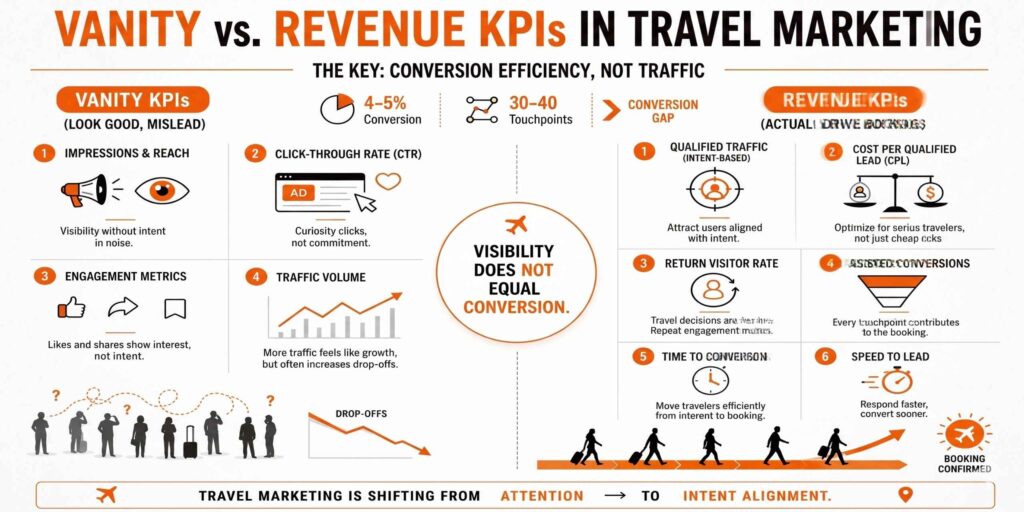
Vanity KPIs in Travel Marketing (And Why They Mislead)
Let’s start with the metrics most teams celebrate.
1. Impressions & Reach
High reach often gets mistaken for growth. But in travel, visibility without intent is noise.
You can scale impressions endlessly without improving bookings. In fact, broader reach often dilutes audience quality.
2. Click-Through Rate (CTR)
Travel ads naturally perform well on CTR because they are:
- visual
- aspirational
- emotionally appealing
But a click in travel often represents curiosity, not commitment.
3. Engagement Metrics
- likes
- shares
- saves
These are useful indicators of interest, but not decision-making.
Even though 80%+ travelers use social platforms for inspiration, engagement rarely correlates directly with bookings (Champ Digital).
4. Traffic Volume
More traffic feels like growth.
But in travel, where decisions are layered and slow, unqualified traffic increases drop-offs, not revenue.
What Actually Drives Performance in Travel
If vanity metrics don’t define success, what does?
1. Qualified Traffic (Intent-Based Acquisition)
Not all traffic is equal.
High-performing travel platforms focus on attracting users who are already aligned with:
- experience type
- travel intent
- destination mindset
This reduces:
- bounce rate
- friction
- decision fatigue
2. Time to Conversion
Travel is not an impulse purchase.
With users interacting across dozens of touchpoints, the real KPI becomes:
👉 how efficiently you move them through the funnel
3. Cost per Qualified Lead (Not Cost per Click)
Most brands optimize for:
👉 lower CPC
But the better metric is:
👉 cost per serious traveler
Because:
- cheap clicks often don’t convert
- high-intent users drive actual revenue
4. Return Visitor Rate
Travel decisions are iterative.
Users:
- revisit
- compare
- reconsider
A strong platform tracks and improves repeat engagement, not just first-time visits.
5. Assisted Conversions
In travel, conversions rarely happen in a single session.
Understanding:
- first touch
- mid-funnel interactions
- remarketing impact
is critical to evaluating performance.
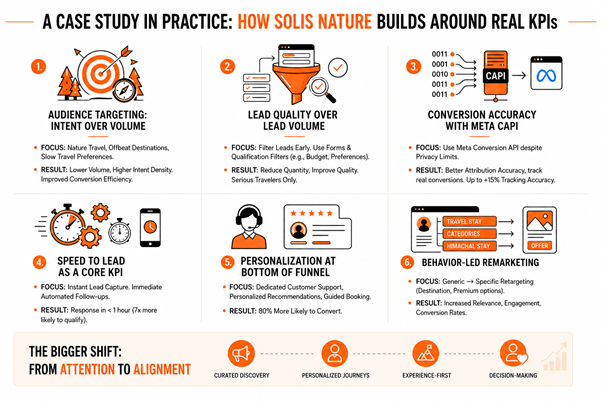
A Case Study in Practice: How Solis Nature Builds Around Real KPIs
What makes Solis Nature interesting from a marketing perspective is not just its niche positioning but how its entire funnel is designed around intent, speed and qualification.
1. Audience Targeting: Intent Over Volume
Instead of broad targeting, Solis Nature uses interest-based segmentation on Meta to reach users aligned with:
- nature travel
- offbeat destinations
- slow travel preferences
- lower traffic volume
- higher intent density
👉 This results in:
A trade-off most brands avoid but one that improves conversion efficiency.
2. Lead Quality Over Lead Volume
Most travel brands focus on generating more leads.
Solis Nature focuses on filtering leads before they enter the funnel.
Through:
- multi-step lead forms
- layered qualification filters (budget, travel type, preferences)
👉 This ensures:
- only serious travelers move forward
This aligns with a key industry challenge:
61% of marketers say generating high-quality leads is their biggest issue (HubSpot)
Solis Nature solves this by reducing quantity to improve quality.
3. Conversion Accuracy with Meta CAPI
With increasing data privacy restrictions, traditional pixel tracking has become less reliable.
Solis Nature uses Meta Conversion API (CAPI) to:
- improve attribution accuracy
- track real conversions more effectively
- optimize campaigns based on actual outcomes
According to Meta, CAPI can improve conversion tracking accuracy by up to 15%.
This leads to:
- better campaign learning
- more efficient budget allocation
4. Speed to Lead as a Core KPI
One of the most overlooked metrics in travel is response time.
Solis Nature has built automation systems to:
- capture leads instantly
- trigger immediate follow-ups
Why this matters:
👉 Companies that respond within an hour are 7x more likely to qualify leads (Harvard Business Review)
In a category where intent fades quickly, speed becomes a direct conversion lever.
5. Personalization at the Bottom of the Funnel
Most platforms stop at generating leads.
Solis Nature extends the funnel with:
- a dedicated customer support team
- personalized recommendations
- guided booking assistance
This aligns with consumer behavior trends:
👉 80% of consumers are more likely to convert with personalized experiences (Epsilon)
6. Behavior-Led Remarketing
Instead of generic retargeting, Solis Nature focuses on behavior-driven remarketing:
- users browsing Himachal → see Himachal-specific stays
- users exploring premium stays → see curated luxury options
👉 This improves:
- relevance
- engagement
- conversion rates
The Bigger Shift: From Attention to Alignment
The core shift in travel marketing is this:
👉 from visibility → to intent alignment
The industry is moving toward:
- curated discovery
- personalized journeys
- experience-first decision-making
Supporting trends:
- Travel content engagement is growing significantly (Zeta Global)
- Travelers are increasingly choosing offbeat and meaningful experiences over mainstream destinations
Final Takeaway
Vanity KPIs tell you:
👉 how many people saw you
Performance KPIs tell you:
👉 how many people moved forward
The difference between the two defines whether a travel brand scales—or stalls.
Platforms like Solis Nature are not outperforming because they spend more.
They are outperforming because they:
- attract the right audience
- filter intent early
- optimize for speed and personalization
- and measure what actually matters
In Simple Terms
- Impressions = visibility
- Clicks = curiosity
- Qualified leads = intent
- Conversions = alignment
And in travel marketing today,
alignment is what drives growth.