
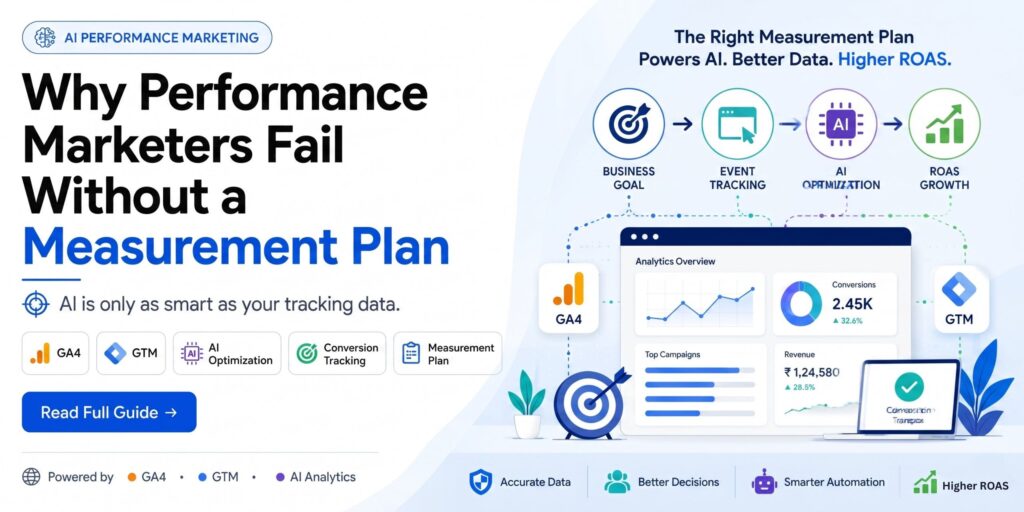
Artificial Intelligence is no longer the future of digital marketing — it is the operating system behind modern performance campaigns.
From Google Performance Max campaigns to Meta Advantage+ Shopping campaigns, AI-driven automation now controls targeting, bidding, audience discovery, creative optimization, and conversion forecasting.
But despite all this innovation, most businesses still make one critical mistake:
They use AI before fixing their measurement system.
And that is exactly why many campaigns fail.
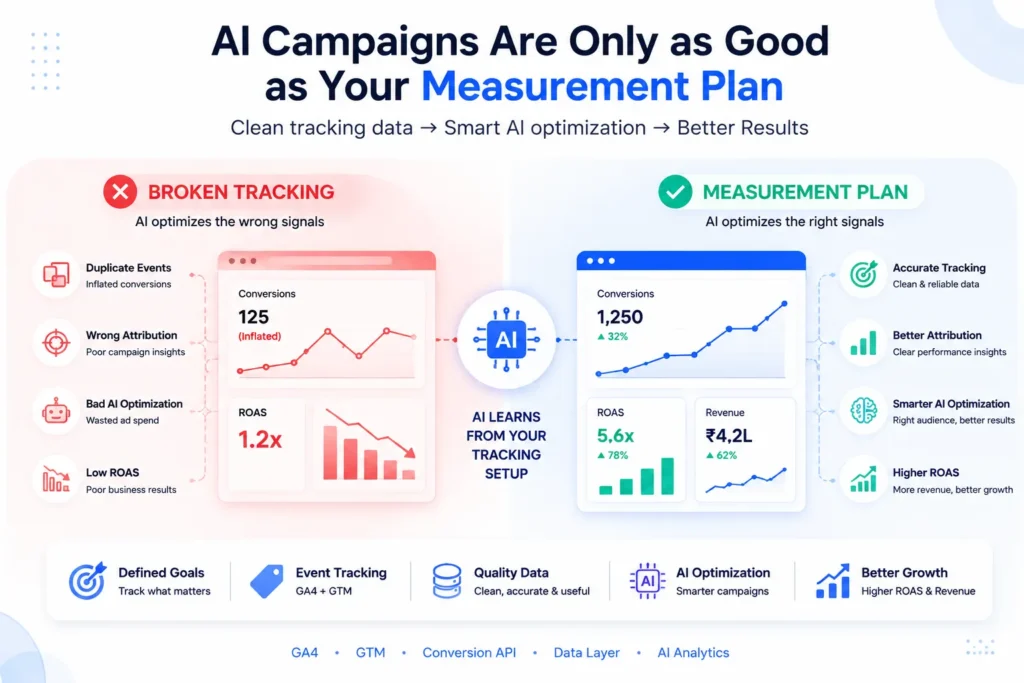
AI does not understand your business goals automatically. It only understands the signals you send through your tracking setup. If your data is inaccurate, duplicated, incomplete, or poorly structured, AI platforms will optimize for the wrong outcomes — often wasting significant advertising budget.
This is why elite performance marketers do not start with automation.
They start with a Measurement Plan.
At IILD Official Website, marketers are trained to build tracking-first marketing systems where analytics, attribution, and AI optimization work together to generate scalable business growth.
Why Measurement Matters More Than Ever in the AI Era
Traditional digital marketing gave marketers manual control.
You could:
- Adjust keyword bids manually
- Pause low-performing audiences
- Optimize placements yourself
- Control campaign-level targeting
Modern AI advertising platforms work differently.
Today, platforms like:
- Google Performance Max
- Meta Advantage+
- LinkedIn Campaign Automation
- Programmatic DSP algorithms
- AI-powered smart bidding systems
…all rely heavily on machine learning models.
These systems learn from your conversion signals.
That means:
- Wrong signals = wrong optimization
- Missing signals = weak performance
- Duplicate signals = inflated reporting
- Poor attribution = wasted budget
In simple words:
AI is only as intelligent as the tracking architecture behind it.
What Is a Measurement Plan?
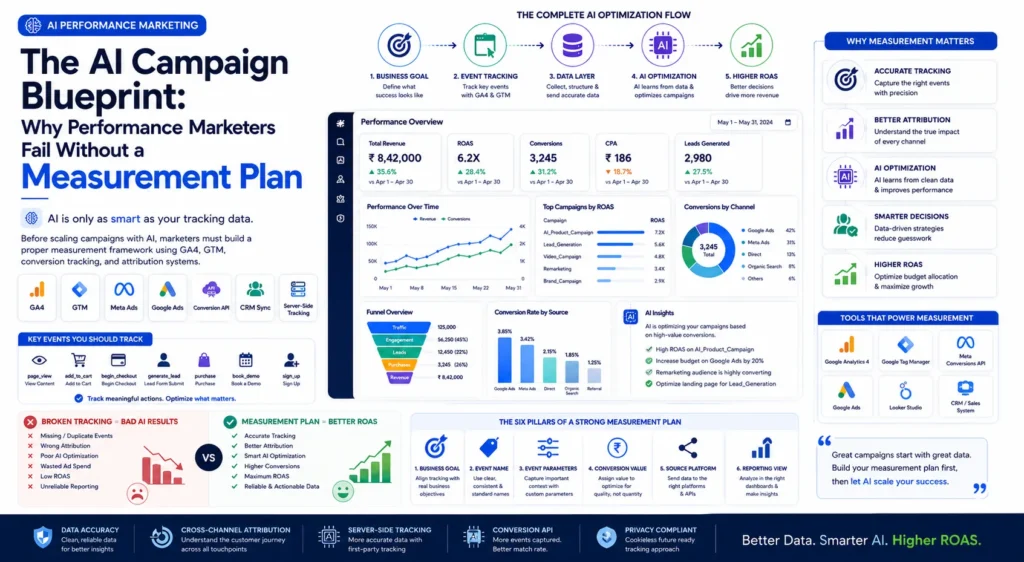
A Measurement Plan is a structured framework that connects business goals with analytics implementation.
It defines:
| Measurement Component | Purpose |
| Business Goal | What the company wants to achieve |
| Event Name | What user action should be tracked |
| Event Parameters | Additional context about the action |
| Conversion Value | Monetary or strategic importance |
| Source Platform | Where the data should be sent |
| Reporting View | Where the performance will be analyzed |
Think of it as the blueprint for your analytics ecosystem.
Without a proper plan, most businesses face:
- Broken GA4 tracking
- Duplicate conversions
- Missing purchase values
- Incorrect attribution
- Poor AI optimization
- Confusing reports
- Unreliable dashboards
And eventually:
- High CPA
- Low ROAS
- Weak lead quality
- Scaling problems
The Biggest AI Optimization Problem Nobody Talks About
Most marketers tell AI systems:
- “Get me more leads”
- “Reduce CPA”
- “Improve ROAS”
- “Scale conversions”
But they rarely verify whether the platform is measuring those conversions correctly.
For example:
Scenario 1: Duplicate Lead Events
If a “generate_lead” event fires twice after one form submission:
- Meta may report double leads
- Google Ads may optimize toward fake conversions
- Your CPL appears artificially low
- AI bidding gets corrupted
Result?
The algorithm aggressively finds low-quality users because it believes your campaign is performing better than reality.
Scenario 2: Missing Purchase Values
If purchase revenue is not passed correctly into GA4:
- Google Ads cannot identify high-value buyers
- ROAS optimization becomes inaccurate
- Value-based bidding fails
- Smart bidding underperforms
AI cannot optimize toward revenue if revenue data does not exist.
Scenario 3: Broken Attribution
If UTM tracking or source attribution is inconsistent:
- GA4 reports incorrect traffic sources
- Retargeting audiences become unreliable
- Multi-channel reporting breaks
- Decision-making becomes impossible
This is why modern performance marketers focus heavily on:
- Tracking infrastructure
- Data architecture
- Event consistency
- Attribution logic
- Conversion quality
The Core Components of a High-Performance Measurement Plan
1. Business Goal (The Foundation)
Every measurement strategy must begin with a business objective.
Examples include:
- Generate qualified leads
- Increase e-commerce sales
- Boost webinar registrations
- Improve demo bookings
- Increase course admissions
- Drive subscription renewals
The biggest mistake marketers make is tracking metrics instead of outcomes.
A high CTR means nothing if revenue is poor.
A low CPC means nothing if lead quality is weak.
Professional marketers optimize for business growth — not vanity metrics.
2. Event Naming Strategy
In Google Analytics 4 GA4, everything is event-driven.
That makes event naming extremely important.
Good event naming creates:
- Cleaner reporting
- Better AI optimization
- Easier dashboarding
- More accurate analysis
Recommended examples:
- generate_lead
- purchase
- add_to_cart
- begin_checkout
- book_demo
- sign_up
- download_brochure
Avoid inconsistent naming like:
- leadsubmit
- formSubmit
- form_submission
- submitLeadNow
Standardization matters.
3. Event Parameters (The Intelligence Layer)
Events alone only tell you that an action happened.
Parameters explain the context behind that action.
Example:
Event:
generate_lead
Parameters:
- course_name
- lead_source
- city
- campaign_name
- lead_quality
- traffic_source
Parameters help marketers answer advanced questions like:
- Which campaigns generate high-quality leads?
- Which city delivers highest ROAS?
- Which audience converts best?
- Which traffic source produces premium customers?
This is where AI becomes significantly smarter.
4. Conversion Values (Value-Based Optimization)
Not all conversions should be treated equally.
For example:
| Conversion Type | Estimated Value |
| Newsletter Signup | ₹50 |
| Webinar Registration | ₹200 |
| Qualified Lead | ₹1,000 |
| Consultation Booking | ₹2,500 |
| Product Purchase | Dynamic Revenue |
Assigning conversion values helps AI systems prioritize quality over quantity.
This powers:
- Value-based bidding
- Revenue optimization
- Smart ROAS bidding
- Predictive optimization
- Budget prioritization
Without values, AI assumes every conversion has equal importance.
That is a major optimization mistake.
5. Source Platform Mapping
Your measurement plan should clearly define where data travels.
Examples:
- Google Analytics 4
- Google Tag Manager
- Google Ads
- Meta Ads
- LinkedIn Ads
- CRM systems
- BI dashboards
- Server-side APIs
This ensures consistent attribution and reporting across all marketing systems.
6. Reporting View (Single Source of Truth)
One of the biggest business problems is disconnected reporting.
Marketing sees one number.
Sales sees another.
Finance sees something completely different.
A professional measurement framework solves this by centralizing reporting.
Popular reporting systems include:
- GA4 Explorations
- Looker Studio
- CRM dashboards
- Power BI
- Internal BI systems
A single source of truth improves:
- Decision-making
- Budget forecasting
- Performance analysis
- Team alignment
Sample Performance Marketing Measurement Framework
| Funnel Stage | Business Goal | Event Name | Key Parameters | Conversion Value | Reporting View |
| TOFU | Awareness | view_item | page_path, category | ₹0 | GA4 |
| MOFU | Engagement | download_brochure | course_name | ₹100 | Looker Studio |
| BOFU | Lead Generation | generate_lead | lead_type, city | ₹1,000 | CRM |
| BOFU | Sales | purchase | transaction_id, value | Dynamic | GA4 + CRM |
This creates alignment between:
- Marketing teams
- Sales teams
- Analytics teams
- AI systems
- Leadership reporting
Why GA4 and GTM Are Essential for Modern Tracking
Modern measurement systems rely heavily on two technologies:
Google Tag Manager (GTM)
GTM acts as the deployment layer.
It helps marketers:
- Deploy tags faster
- Manage tracking centrally
- Reduce developer dependency
- Test tracking efficiently
- Implement custom events
- Push dataLayer variables
Google Analytics 4 (GA4)
GA4 acts as the analytics engine.
It helps marketers analyze:
- User journeys
- Attribution paths
- Engagement behavior
- Audience segments
- Conversion trends
- Cross-device behavior
Together, GTM and GA4 create the foundation of scalable AI-driven marketing.
The Rise of Server-Side Tracking and Conversion APIs
Browser tracking is becoming less reliable because of:
- Ad blockers
- Cookie restrictions
- iOS privacy updates
- Browser privacy policies
That is why advanced marketers now use:
- Meta Conversions API
- Server-side GTM
- Enhanced Conversions
- First-party data tracking
Benefits include:
- Better attribution accuracy
- Improved event matching
- More stable conversion reporting
- Stronger AI optimization
- Reduced data loss
The future of measurement is first-party data infrastructure.
Common Measurement Planning Mistakes
Tracking Too Many Events
More data does not equal better insights.
Track meaningful business actions only.
Ignoring Conversion Quality
Not every lead has equal intent.
Track:
- lead_score
- qualification_status
- sales_stage
- customer_value
No Event Testing
Always validate using:
- GTM Preview Mode
- GA4 DebugView
- Browser testing
- Test purchases
- CRM matching
Broken tracking silently destroys campaign performance.
Optimizing Vanity Metrics
Avoid focusing only on:
- Impressions
- Clicks
- CTR
- CPC
Instead prioritize:
- Revenue
- Profitability
- ROAS
- LTV
- Lead quality
- Retention
Why Measurement Planning Will Dominate Performance Marketing in 2026
The marketing industry is rapidly becoming:
- AI-driven
- Privacy-focused
- Automation-heavy
- Data-dependent
Future-ready marketers must understand:
- Analytics architecture
- Attribution modeling
- Server-side tracking
- Event strategy
- Data quality
- AI optimization logic
The best marketers today are no longer just media buyers.
They are:
- Data strategists
- Tracking architects
- Analytics thinkers
- Growth system builders
And all of that starts with a Measurement Plan.
Final Thoughts
Before asking AI to optimize your campaigns, ask yourself one critical question:
“Am I measuring the right things correctly?”
Because AI cannot fix broken tracking.
It only amplifies it.
A strong Measurement Plan helps businesses achieve:
- Better campaign optimization
- Higher ROAS
- Cleaner attribution
- Smarter automation
- Better reporting
- Scalable growth
In the AI era, data quality is your competitive advantage.
And marketers who master measurement will dominate the future of performance marketing.
To learn advanced GA4, GTM, conversion tracking, attribution systems, and AI-powered performance marketing strategies, explore the professional programs available at IILD Official Website