Introduction: Marketing’s Biggest Shift Since Mobile
Digital marketing is experiencing its most significant transformation since the rise of smartphones.
For over a decade, marketers relied heavily on third-party cookies, external audience databases, and platform-driven targeting. These tools enabled rapid customer acquisition but created a dependency on data that businesses did not truly own.
Today, that model is breaking down.
Privacy regulations are becoming stricter. Browser restrictions are limiting tracking capabilities. Consumers are demanding greater transparency about how their information is collected and used.
As a result, marketers are entering a new era where growth is no longer powered by rented audiences—it is powered by owned customer intelligence.
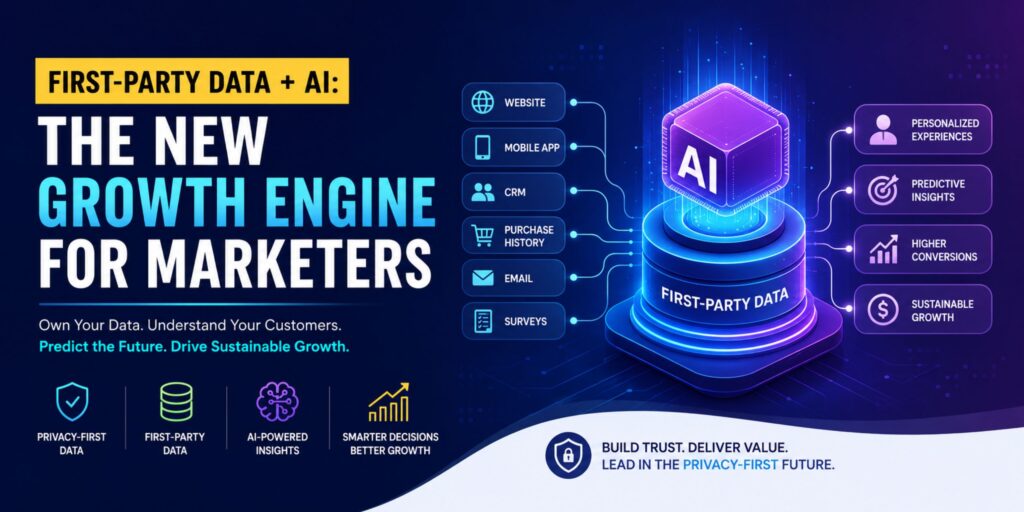
This is where the combination of First-Party Data and Artificial Intelligence (AI) becomes a game-changing competitive advantage.
Organizations that successfully combine these two assets can unlock deeper customer understanding, predictive decision-making, better personalization, and significantly higher marketing ROI.
The future of performance marketing belongs to brands that own their data and use AI to activate it intelligently.
Understanding First-Party Data: Your Most Valuable Marketing Asset
First-party data is information collected directly from customers through interactions with your brand.
Unlike third-party data, it is gathered through consent-based channels such as:
- Website visits
- Mobile applications
- CRM systems
- Email campaigns
- Purchase history
- Customer support interactions
- Loyalty programs
- Surveys and feedback forms
- Webinar registrations
- Lead generation forms
This data provides marketers with something increasingly rare in today’s digital landscape: certainty.
Instead of relying on assumptions, marketers gain access to actual customer behavior, preferences, interests, and buying patterns.
Why First-Party Data Matters More Than Ever
Higher Accuracy
The data comes directly from customer interactions, making it significantly more reliable than third-party sources.
Better Privacy Compliance
Since the information is collected with consent, businesses can build sustainable marketing systems that align with privacy regulations.
Stronger Customer Relationships
First-party data enables personalized experiences that improve engagement, trust, and loyalty.
Long-Term Competitive Advantage
Unlike advertising platforms that can change algorithms overnight, first-party data remains a proprietary business asset.
The End of the Cookie Era and What It Means for Marketers
The marketing industry is moving toward a privacy-first ecosystem.
Several major changes are driving this shift:
Stricter Data Privacy Regulations
Governments worldwide are introducing regulations that require greater transparency and consent in data collection practices.
Reduced Third-Party Tracking
Browser restrictions and platform changes are making traditional tracking methods less effective.
Increased Customer Expectations
Modern consumers expect personalized experiences while simultaneously demanding privacy protection.
Rising Customer Acquisition Costs
As targeting becomes more challenging, acquiring new customers through paid advertising is becoming increasingly expensive.
These changes are forcing marketers to rethink how they collect, analyze, and activate customer data.
Why AI Is Becoming Essential for Modern Marketing
Collecting data is only half the equation.
Most organizations already possess enormous amounts of customer information.
The challenge lies in turning that information into actionable insights.
Artificial Intelligence solves this problem.
AI can process millions of customer interactions, identify hidden patterns, and generate recommendations faster than any human team.
Instead of simply reporting what happened, AI helps marketers understand:
- Why it happened
- What is likely to happen next
- What action should be taken
This shift from reactive marketing to predictive marketing is transforming how businesses grow.
First-Party Data + AI: The Ultimate Growth Engine
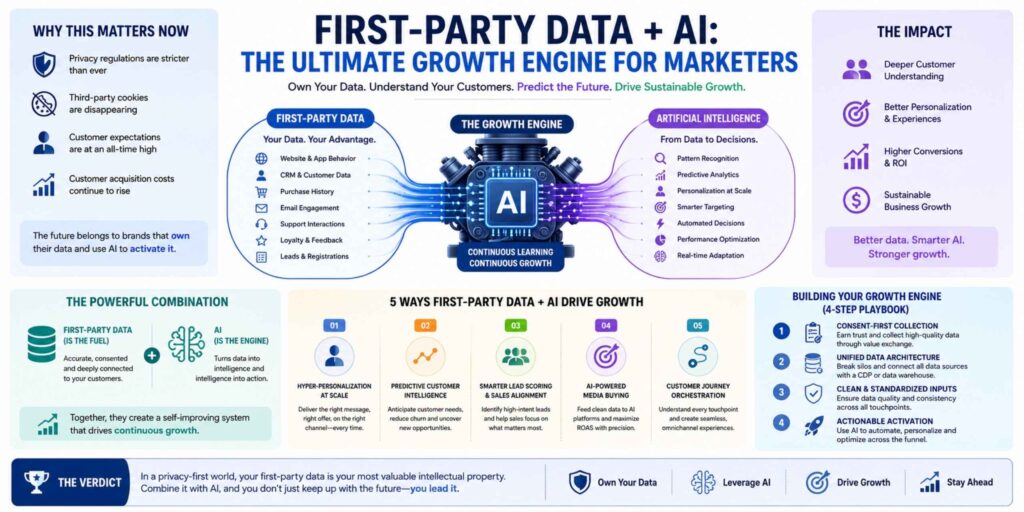
Think of first-party data as fuel and AI as the engine.
Without quality data, AI produces weak insights.
Without AI, valuable customer data often sits unused inside CRMs and analytics platforms.
Together, they create a self-improving system that drives continuous growth.
1. Hyper-Personalization at Scale
Personalization is no longer optional.
Customers expect brands to understand their needs and deliver relevant experiences.
AI can analyze:
- Browsing behavior
- Purchase history
- Product preferences
- Engagement patterns
- Device usage
This enables businesses to deliver:
- Personalized emails
- Dynamic website content
- Product recommendations
- Customized offers
- Tailored customer journeys
Instead of marketing to segments, brands can market to individuals.
2. Predictive Customer Intelligence
One of AI’s most valuable capabilities is prediction.
Using historical first-party data, AI can forecast:
- Purchase probability
- Customer lifetime value (CLV)
- Churn risk
- Upsell opportunities
- Future buying behavior
This allows marketers to proactively influence outcomes before opportunities are lost.
3. Smarter Lead Scoring and Sales Alignment
Traditional lead scoring models often rely on manual rules.
AI-powered lead scoring uses behavioral data to identify high-intent prospects.
Sales teams can focus their efforts on leads most likely to convert, resulting in:
- Higher conversion rates
- Shorter sales cycles
- Better marketing-sales alignment
4. AI-Powered Media Buying
Platforms such as Google Ads, Meta Ads, and LinkedIn Ads increasingly depend on machine learning algorithms.
When advertisers provide high-quality first-party conversion data, AI can:
- Improve audience targeting
- Optimize bidding strategies
- Enhance conversion modeling
- Increase ROAS
- Reduce wasted ad spend
The quality of data directly impacts the quality of AI-driven optimization.
5. Customer Journey Orchestration
Modern customer journeys are complex.
A customer may discover a brand through social media, visit the website multiple times, subscribe to emails, and purchase weeks later.
AI helps marketers connect these interactions and determine:
- Which touchpoints influence conversion
- When customers are ready to buy
- Which channels deliver the highest value
This creates a seamless omnichannel experience.
The Role of Server-Side Tracking in the AI Era
One of the most important developments in modern analytics is server-side tracking.
Traditional browser-based tracking is becoming less reliable due to privacy restrictions.
Server-side tracking allows businesses to:
- Improve data accuracy
- Reduce data loss
- Strengthen attribution
- Feed cleaner conversion signals into AI systems
For performance marketers, server-side tracking is quickly becoming a necessity rather than an option.
Real-World Applications Across Industries
E-commerce
AI-driven recommendations increase average order value and repeat purchases.
Education & EdTech
Predictive models identify students most likely to enroll in training programs.
Healthcare
AI helps personalize patient engagement and improve communication.
SaaS Businesses
Predictive analytics identify accounts at risk of churn.
Financial Services
AI enhances customer segmentation and personalized product recommendations.
Building a First-Party Data and AI Strategy: A Practical Framework
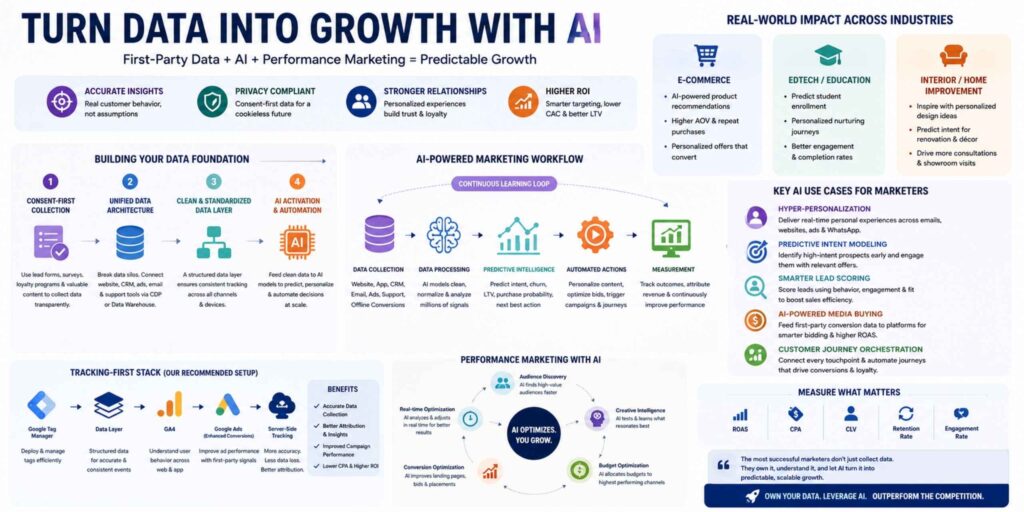
Step 1: Audit Your Data Ecosystem
Identify all customer data sources.
Step 2: Create a Unified Customer View
Integrate CRM, analytics, ad platforms, and customer service tools.
Step 3: Implement Data Governance
Ensure data quality, privacy compliance, and standardized collection processes.
Step 4: Deploy AI Use Cases
Start with high-impact opportunities such as:
- Predictive lead scoring
- Email personalization
- Customer retention modeling
- AI-powered bidding
Step 5: Measure and Optimize
Track KPIs including:
- Customer Lifetime Value
- Conversion Rate
- Cost Per Acquisition
- Retention Rate
- Return on Ad Spend
Challenges Marketers Must Prepare For
While the opportunities are immense, successful implementation requires overcoming:
Data Silos
Disconnected systems limit AI effectiveness.
Poor Data Quality
AI is only as effective as the data it receives.
Talent Gaps
Organizations need professionals who understand both marketing and AI.
Privacy Compliance
Trust and transparency must remain central to every data strategy.
The Future: Autonomous Marketing Systems
The next evolution of marketing will involve autonomous AI systems that can:
- Analyze customer behavior
- Generate audience segments
- Create campaign variations
- Optimize budgets
- Predict business outcomes
Human marketers will increasingly focus on strategy, creativity, and governance while AI handles execution and optimization.
The organizations preparing for this future today will dominate tomorrow’s marketplace.
Conclusion
The future of marketing is not about collecting more data.
It is about collecting better data and using AI to unlock its value.
First-party data provides the foundation. AI provides the intelligence.
Together, they enable marketers to move beyond reactive campaigns and build predictive, personalized, and scalable growth systems.
As privacy regulations continue to evolve and customer expectations continue to rise, businesses that invest in first-party data infrastructure and AI-powered decision-making will gain a lasting competitive advantage.
In the years ahead, the most successful marketers will not be those with the biggest budgets.
They will be the ones with the smartest data and the most intelligent systems.