
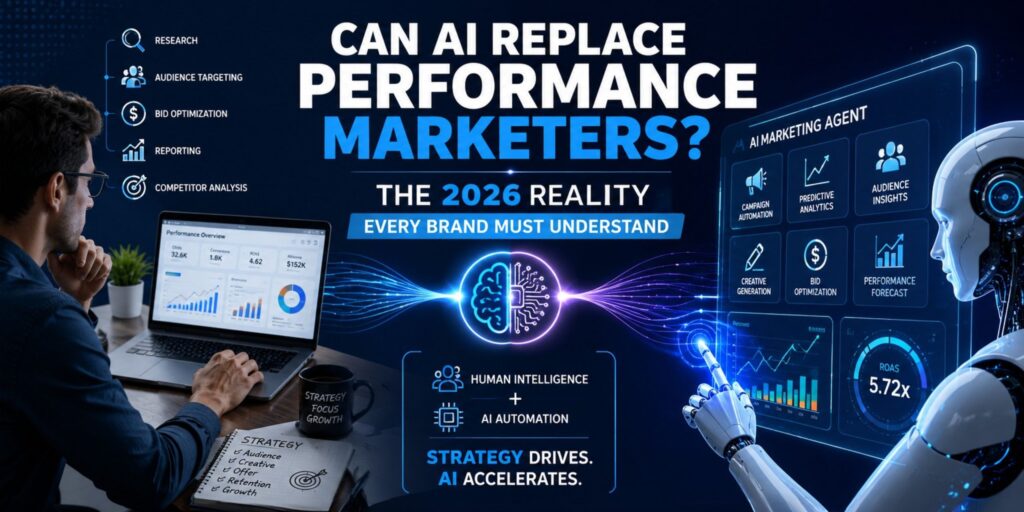
Artificial Intelligence has completely transformed the digital marketing industry. From automated bidding and predictive targeting to AI-generated creatives and autonomous reporting systems, marketers are witnessing the biggest shift since the birth of Google Ads and social media advertising.
But one question still dominates conversations across agencies, startups, and enterprise brands:
Will AI replace performance marketers?
The short answer is no.
The real answer is more important:
AI will replace repetitive marketing tasks, but it will not replace strategic marketers who understand psychology, business growth, data interpretation, and creative decision-making.
In 2026, performance marketing is no longer about manually adjusting bids or downloading spreadsheets. The industry has entered the era of Human + AI Collaboration, where AI handles scale and automation while humans provide direction, strategy, creativity, and business intelligence.
This new reality is not about humans competing against machines. It is about marketers learning how to lead intelligent systems effectively.
The Evolution of Performance Marketing
A few years ago, performance marketing depended heavily on manual work:
- Keyword research
- Audience targeting
- Bid optimization
- Campaign monitoring
- Ad copy testing
- Reporting
- Conversion tracking
- Competitor analysis
Today, AI platforms can perform most of these activities automatically.
Platforms like:
- Google Ads AI Max
- Performance Max
- Meta Advantage+
- TikTok Smart Performance Campaigns
- LinkedIn Predictive Audiences
- AI-powered analytics platforms
can now make thousands of optimization decisions every second.
What once required a full marketing team can now be handled by a small strategic unit supported by AI systems.
But automation has created a new problem:
When everyone has access to the same AI tools, strategy becomes the only true competitive advantage.
That is where human marketers remain essential.
The Death of Manual Marketing Work
The biggest transformation in 2026 is the disappearance of repetitive operational work.
Tasks that previously consumed entire workdays now take minutes.
What AI Handles Automatically Today
AI systems can now:
- Generate campaign structures
- Build audience segments
- Predict customer intent
- Create multiple ad variations
- Analyze search trends
- Forecast ROAS
- Detect anomalies in reports
- Adjust bids in real time
- Generate dashboards instantly
- Identify conversion drop-offs
- Automate remarketing sequences
Modern AI research agents can even produce detailed market reports with citations, competitor breakdowns, and customer insights within minutes.
This means marketers no longer spend most of their time collecting data.
Instead, they spend time interpreting it.
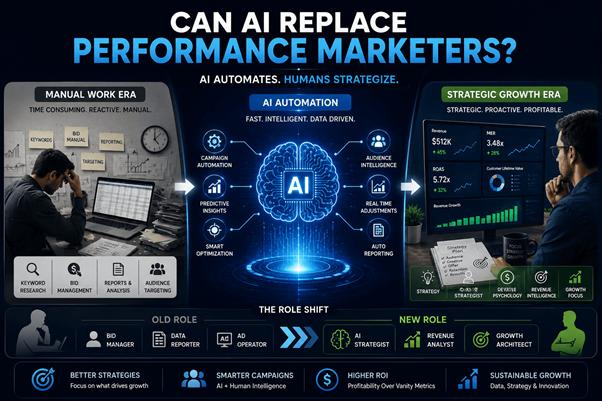
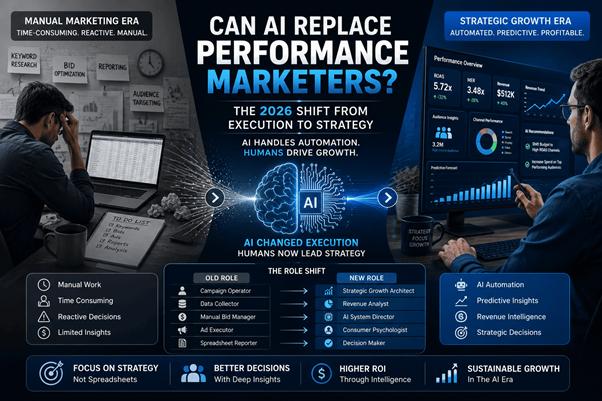
The role has shifted from:
| Old Role | New Role |
| Campaign Operator | Strategic Growth Architect |
| Data Collector | Revenue Analyst |
| Manual Bid Manager | AI System Director |
| Ad Executor | Consumer Psychologist |
| Spreadsheet Reporter | Decision Maker |
This is one of the biggest professional shifts the industry has ever seen.
Why AI Still Cannot Replace Human Marketers
Despite incredible advancements, AI still lacks several capabilities that are essential for profitable business growth.
1. AI Lacks Human Psychology
AI understands patterns.
Humans understand emotions.
Performance marketing is not just about clicks. It is about influencing behavior, trust, urgency, desire, fear, aspiration, and decision-making.
AI can generate ad copy, but it often lacks:
- Cultural nuance
- Emotional storytelling
- Brand personality
- Human empathy
- Social awareness
- Humor
- Timing sensitivity
The most successful campaigns in 2026 are still built around human emotional insight.
Because consumers do not buy products logically.
They buy emotionally and justify rationally.
2. AI Does Not Understand Business Context
AI optimizes for the signals it receives.
If your tracking setup is poor, your AI becomes dangerous instead of helpful.
For example:
- AI may optimize for cheap leads instead of qualified leads
- AI may target low-quality traffic sources
- AI may inflate branded search performance
- AI may prioritize clicks over profitability
- AI may overspend on low-intent audiences
Without strategic guidance, AI often creates the illusion of performance while hurting actual business growth.
This is why marketers must build:
- Proper conversion architecture
- Accurate attribution systems
- First-party data pipelines
- CRM integrations
- Revenue tracking systems
AI cannot invent business intelligence.
Humans must provide the framework.
The Rise of Revenue Intelligence
In earlier years, marketers focused heavily on vanity metrics:
- CTR
- CPC
- Impressions
- Reach
- Engagement
But modern businesses care about one thing:
Revenue profitability.
That is why performance marketers in 2026 focus on deeper business metrics.
The New Performance Marketing Metrics
| Old Metrics | Modern Revenue Metrics |
| Clicks | Qualified Leads |
| ROAS | MER (Marketing Efficiency Ratio) |
| CPL | Customer Acquisition Cost |
| Last Click Attribution | Customer Lifetime Value |
| Conversion Volume | Revenue Quality |
| Engagement | Incremental Revenue |
AI can optimize campaigns.
But humans must decide:
- What defines a high-quality customer
- Which customers are profitable long-term
- How much acquisition cost is sustainable
- Which products deserve scaling
- Which channels deserve budget allocation
This is strategic business thinking, not automation.
AI Has Changed Creative Production Forever
Now AI tools can generate:
Creative production used to be slow and expensive.
- Ad headlines
- Video scripts
- Visual concepts
- Voiceovers
- Image variations
- Landing page copy
- Product descriptions
- Social media hooks
within seconds.
But there is a major difference between:
AI-generated content
and
high-converting creative strategy.
The Problem With Pure AI Creative
Many AI-generated ads feel generic because they lack:
- Authenticity
- Real customer insight
- Emotional tension
- Strong positioning
- Human storytelling
This is why creative strategy has become the new competitive advantage.
In 2026, winning brands use AI for production speed while humans control:
- Messaging angles
- Consumer psychology
- Offer positioning
- Narrative structure
- Brand tone
- Emotional triggers
The marketer becomes the creative director of the AI system.
The Future Belongs to First-Party Data
One of the most important changes happening right now is the collapse of third-party tracking.
Cookies are disappearing.
Privacy regulations are increasing.
Platforms have limited visibility.
This means marketers must build stronger first-party data ecosystems.
Modern Performance Marketers Must Understand
- Server-side tracking
- GA4 event architecture
- Conversion APIs
- CRM integrations
- Data warehousing
- Attribution modeling
- Consent management
- Customer data platforms
AI systems are only as intelligent as the data they receive.
Bad tracking creates bad optimization.
This is why technical marketing skills are becoming more valuable than ever.
Share of Model: The New SEO Battle
Traditional SEO focused on ranking on Google.
But 2026 introduced a new concept:
Share of Model
This measures how often AI assistants recommend your brand.
Consumers increasingly rely on:
- Gemini
- ChatGPT
- Claude
- Perplexity
- Shopping agents
- AI search assistants
Instead of clicking blue links, users now ask AI systems for recommendations directly.
That means brands must optimize for:
- Structured data
- API accessibility
- Product feeds
- Knowledge graphs
- Entity authority
- Generative Engine Optimization (GEO)
The future of visibility is no longer just search ranking.
It is AI recommendation visibility.
The Biggest Skill in 2026: Strategic Thinking
Since AI has democratized campaign optimization, everyone now has access to powerful automation.
This creates a new reality:
The brands with the best strategy win.
Not the brands with the biggest automation tools.
Modern marketers must master:
- Consumer behavior
- Offer creation
- Positioning
- Funnel psychology
- Landing page optimization
- Retention systems
- Revenue forecasting
- Brand differentiation
AI can optimize execution.
But it cannot create vision.
What Performance Marketing Teams Look Like in 2026
The structure of marketing teams has changed dramatically.
Smaller Teams. Bigger Output.
Modern teams often include:
1. Strategic Growth Lead
Focuses on revenue planning, business goals, and scaling decisions.
2. AI Systems Operator
Manages automation workflows, integrations, prompts, and optimization systems.
3. Creative Strategist
Develops emotional messaging, hooks, and storytelling frameworks.
4. Data & Attribution Specialist
Handles tracking, server-side implementation, and reporting accuracy.
5. Content & Community Lead
Builds brand trust and audience engagement.
AI replaces repetitive execution, but human specialization becomes more important.
The Risks of Over-Reliance on AI
While AI is powerful, blind automation creates serious risks.
Common AI Marketing Mistakes
1. Over-Automation
Too much automation without oversight leads to wasted budget.
2. Generic Creative
AI-generated ads often look similar across brands.
3. Weak Brand Identity
Automation can dilute unique positioning.
4. Data Dependency
Poor tracking destroys AI optimization quality.
5. Loss of Human Insight
Algorithms cannot fully understand human emotion or social context.
The most successful marketers use AI as a tool, not as a replacement for thinking.
The Real Future of Performance Marketing
The future is not human vs AI.
The future is:
Human Intelligence + Artificial Intelligence
AI provides:
- Speed
- Scale
- Automation
- Prediction
- Processing power
Humans provide:
- Creativity
- Emotion
- Vision
- Ethics
- Strategy
- Business judgment
Together, they create the modern growth engine.
Final Verdict: Will AI Replace Performance Marketers?
No.
But performance marketers who refuse to adapt will struggle.
The industry is evolving from:
- Manual optimization → Predictive optimization
- Static targeting → Dynamic personalization
- Reactive marketing → Real-time intelligence
- Campaign management → Revenue architecture
The marketer of the future is no longer just a media buyer.
They are:
- A strategist
- A data interpreter
- A creative thinker
- A growth architect
- An AI systems leader
The winners in 2026 will not be the people fighting AI.
They will be the marketers who learn how to steer it better than everyone else.
Conclusion
AI has permanently changed performance marketing, but it has not eliminated the need for marketers.
Instead, it has elevated the role.
The repetitive work is disappearing.
Strategic thinking is becoming more valuable.
Brands that combine AI automation with strong human creativity, accurate data systems, and deep customer understanding will dominate the next era of digital growth.
The future does not belong to AI alone.
It belongs to marketers who know how to combine technology with human intelligence.
For more insights on AI, digital marketing, analytics, and modern growth systems, explore IILD Services.