
Introduction: The Analytics Mindset Shift Most Marketers Haven’t Made
When Google officially retired Universal Analytics (UA), the industry rushed to migrate to Google Analytics 4 (GA4). Tracking codes were updated, properties were created, and reports were rebuilt.
Yet years later, many marketing teams continue to struggle—not because GA4 is difficult, but because they’re using it with a Universal Analytics mindset.
This is where the real problem begins.
GA4 isn’t simply a new reporting interface. It’s a completely different measurement framework designed for a world where:
- Users switch between multiple devices
- Customer journeys span dozens of touchpoints
- Privacy regulations limit traditional tracking
- AI-driven optimization requires richer behavioral data
- Attribution is no longer linear
The marketers who understand this shift are using GA4 to improve campaign efficiency, uncover hidden revenue opportunities, and optimize customer journeys.
Those who don’t are making decisions based on incomplete or misleading data.
Let’s explore the biggest misconceptions marketers still have about GA4 and how to turn analytics into a true growth engine.
Why Google Rebuilt Analytics from the Ground Up
Before comparing features, it’s important to understand why Google replaced Universal Analytics in the first place.
Universal Analytics was built for a desktop-first internet.
Its core assumptions were:
- Users browse websites
- Cookies reliably identify visitors
- Most conversions happen during a single session
- Last-click attribution is sufficient
Today’s reality is different.
A modern customer may:
- Discover a product on YouTube
- Research on mobile search
- Visit the website multiple times
- Engage with remarketing ads
- Purchase through a different device
UA struggled to connect these interactions.
GA4 was designed specifically for this new customer journey.
Mistake #1: Treating GA4 Like Universal Analytics
The most common mistake marketers make is expecting GA4 reports to look and behave exactly like UA.
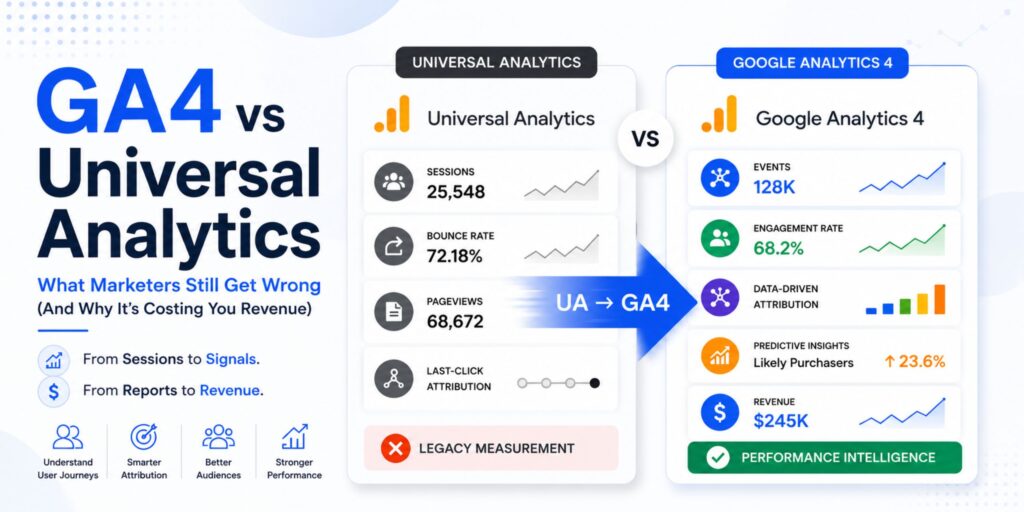
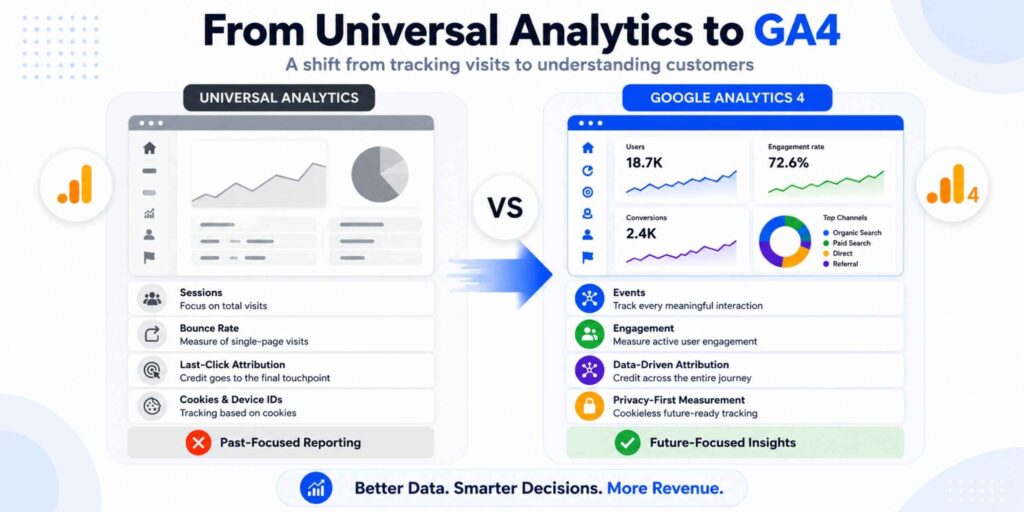
In Universal Analytics, marketers focused on:
- Sessions
- Bounce Rate
- Pageviews
- Average Session Duration
In GA4, the focus shifts toward:
- Events
- Users
- Engagement
- Customer journeys
- Predictive insights
Many marketers compare numbers between the two platforms and assume tracking errors exist when metrics don’t match.
The truth is simpler:
They are measuring different things.
Performance Marketing Perspective
Instead of asking:
“How many visits did my campaign generate?”
Ask:
“Which interactions moved users closer to conversion?”
That single mindset shift changes how campaigns are evaluated and optimized.
Mistake #2: Ignoring the Event-Based Measurement Model
The event-based architecture is arguably the most important change in GA4.
Universal Analytics relied on different hit types:
- Pageview
- Event
- Ecommerce
- Social Interaction
GA4 eliminates those distinctions.
Everything becomes an event.
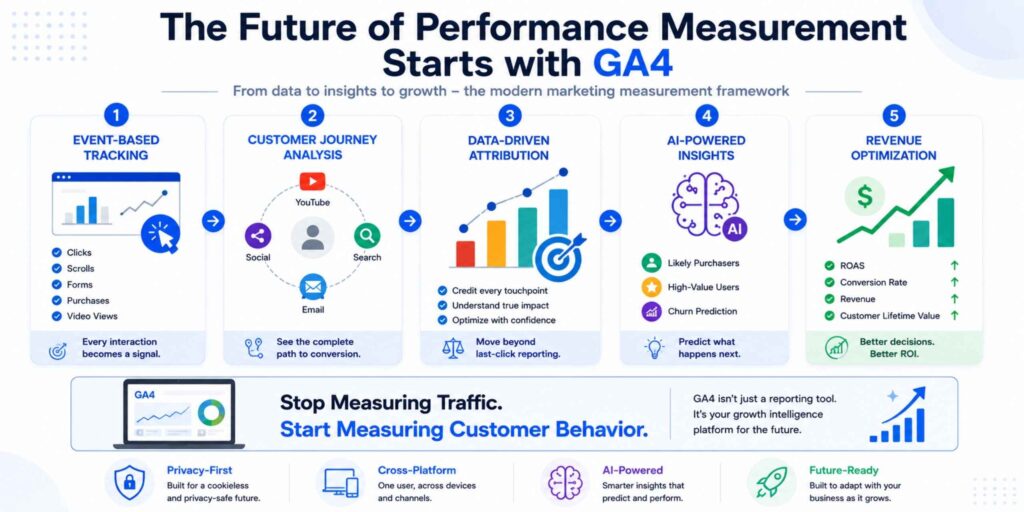
Examples:
- page_view
- scroll
- click
- form_submit
- video_progress
- add_to_cart
- purchase
Every interaction can now become a measurable business signal.
Why This Matters
Most businesses only track:
- Website visits
- Form submissions
- Purchases
This leaves huge blind spots.
High-performing marketers track micro-conversions such as:
- CTA clicks
- Scroll depth
- Product views
- Video engagement
- Pricing page visits
- Demo button clicks
These interactions reveal purchase intent long before a conversion occurs.
Mistake #3: Still Obsessing Over Sessions
Sessions are still available in GA4.
However, they are no longer the primary indicator of success.
Traffic volume doesn’t equal business growth.
A campaign generating:
- 50,000 sessions
- 1% conversion rate
may perform worse than a campaign generating:
- 15,000 sessions
- 8% conversion rate
Better Metrics to Monitor
Performance marketers should prioritize:
- Engaged Sessions
- Engagement Rate
- Revenue Per User
- Conversion Rate
- Customer Lifetime Value
- Return on Ad Spend (ROAS)
These metrics align directly with business outcomes.
Mistake #4: Misunderstanding Attribution Models
Attribution remains one of the most misunderstood areas of digital marketing.
Many marketers still compare:
- Google Ads conversions
- Meta conversions
- LinkedIn conversions
- GA4 conversions
and expect identical numbers.
They never will be.
Each platform uses different attribution logic.
GA4’s default Data-Driven Attribution (DDA) distributes credit across the entire customer journey.
Example
A user:
- Discovers your brand through YouTube
- Clicks a search ad
- Engages with remarketing
- Converts through direct traffic
UA would likely credit the final interaction.
GA4 evaluates all touchpoints.
This provides a more realistic understanding of channel contribution.
Mistake #5: Poor UTM Governance
One of the biggest hidden reporting problems is inconsistent campaign tagging.
Examples:
Bad:
- Facebook-Ad
- FB
- Meta
GA4 treats these as different sources.
This creates fragmented reporting and inaccurate attribution.
Best Practices
Establish company-wide naming conventions for:
- Source
- Medium
- Campaign
- Content
- Term
Clean UTM structures improve both attribution accuracy and audience analysis.
Mistake #6: Not Leveraging Explorations
Many marketers spend their entire lives inside standard reports.
This is a major missed opportunity.
GA4 Explorations provides advanced analysis tools including:
- Funnel Analysis
- Path Analysis
- Cohort Analysis
- Segment Overlap
- User Journey Mapping
These reports reveal exactly where users:
- Drop off
- Convert
- Re-engage
- Abandon forms
- Exit checkout flows
This is where real optimization opportunities live.
Mistake #7: Underestimating Audience Building
GA4 isn’t just a reporting platform.
It’s also an audience intelligence platform.
Marketers can create audiences based on:
- Purchase intent
- Product interest
- Funnel stage
- Customer value
- Engagement behavior
Example Audience Segments
- Visited pricing page but didn’t convert
- Added to cart but abandoned checkout
- Watched 75% of a product video
- Viewed multiple service pages
These audiences significantly improve remarketing performance.
Mistake #8: Ignoring Predictive Metrics and AI Capabilities
One of GA4’s most powerful yet underutilized features is predictive analytics.
GA4 can identify:
- Likely purchasers
- Likely churners
- High-value users
- Future revenue opportunities
These insights help marketers move from reactive reporting to proactive optimization.
Why It Matters
Instead of asking:
“What happened?”
You begin asking:
“What is likely to happen next?”
That is where modern performance marketing is heading.
Mistake #9: Relying Solely on Client-Side Tracking
Privacy regulations and browser restrictions have changed tracking forever.
Ad blockers, cookie limitations, and privacy updates create significant data loss.
Many businesses are unknowingly losing 20–40% of valuable marketing data.
The Solution: Server-Side Tracking
Benefits include:
- Better attribution accuracy
- Improved data quality
- Reduced browser restrictions
- Faster website performance
- Stronger privacy compliance
In 2026, server-side tracking is becoming a competitive advantage rather than a technical luxury.
Mistake #10: Not Connecting GA4 to BigQuery
One of the most powerful Google Analytics 4 features is its native integration with BigQuery.
Yet many organizations never activate it.
BigQuery allows marketers to:
- Store raw analytics data
- Build custom attribution models
- Analyze customer lifetime value
- Combine CRM and analytics data
- Create advanced dashboards
For growing businesses, BigQuery transforms GA4 from a reporting platform into a business intelligence system.
Mistake #11: Measuring Marketing Metrics Instead of Business Outcomes
This is the most expensive mistake of all.
Many teams celebrate:
- More traffic
- More clicks
- More impressions
while revenue remains stagnant.
The purpose of analytics isn’t to generate reports.
It’s to drive profitable growth.
Metrics That Actually Matter
Track:
- Revenue
- Leads
- Pipeline Value
- ROAS
- CAC
- Customer Lifetime Value
- Profitability
Everything else should support those objectives.
The Future of Analytics: From Reporting to Decision Intelligence
The future of digital analytics isn’t dashboards.
It’s decision intelligence.
The next generation of marketers will use analytics to:
- Predict customer behavior
- Automate budget allocation
- Personalize customer journeys
- Improve attribution accuracy
- Drive AI-powered optimization
GA4 is the foundation for that future.
Organizations that continue operating with a Universal Analytics mindset risk falling behind competitors who are using data strategically.
Final Thoughts
The transition from Universal Analytics to GA4 is not a technology upgrade.
It’s a strategic transformation.
The marketers succeeding today are not the ones collecting the most data.
They are the ones collecting better data, understanding customer behavior more deeply, and turning insights into profitable actions.
GA4 rewards marketers who think beyond pageviews and sessions.
The question isn’t whether you’ve migrated to GA4.
The real question is:
Have you migrated your marketing mindset?