
Performance Max (PMax) has evolved from being just another Google Ads campaign type into one of the most debated tools in modern performance marketing. Some marketers call it a growth engine powered by AI. Others call it an expensive black box with limited transparency. So, in 2026 — are Performance Max campaigns really worth it?
Short answer: Yes — but only when managed strategically.
The biggest mistake advertisers make is assuming Performance Max is a shortcut.
It isn’t.
It is an automation layer that amplifies the quality of your strategy, your data, and your creative.
If your tracking, conversion signals, audience data, and campaign structure are strong, PMax can unlock scale that manual campaigns often struggle to reach.
If those foundations are weak, automation can magnify inefficiency.
That’s why the real question is not whether PMax works.
It’s whether you know how to make it work.
What is Performance Max in 2026?
Performance Max is Google’s goal-based, AI-driven campaign type that gives advertisers access to Google’s entire inventory through a single campaign.
This includes:
- Google Search
- YouTube
- Display Network
- Gmail
- Discover
- Google Maps
- Shopping placements
- AI-powered Search experiences and AI Overviews
Unlike traditional Search campaigns built around keyword management, PMax optimizes around:
- Conversion intent
- Audience signals
- Creative asset combinations
- Real-time bidding signals
- Product feeds
- First-party data
- Cross-channel attribution paths
Think of it like this:
Traditional Search = Manual Optimization
Performance Max = AI-Assisted Optimization
The difference is enormous.
Why Performance Max Has Become So Popular
1. Full-Funnel Reach from One Campaign
One of PMax’s biggest advantages is access to every major Google touchpoint.
Instead of building separate campaigns for Search, Shopping, Display, and YouTube, advertisers can let the algorithm dynamically place budget where conversion probability is highest.
That means PMax can capture users across the entire funnel:
- Discovery stage via YouTube or Display
- Consideration through Search and AI Overviews
- Purchase through Shopping or remarketing placements
This unified reach is difficult to replicate manually.
2. AI Optimization at Scale
Google’s machine learning processes signals humans can’t optimize in real time:
- Device behavior
- Location signals
- Search context
- Time-of-day intent
- Purchase probability
- Historical conversion patterns
That allows PMax to automate:
- Smart bidding
- Budget allocation
- Asset combinations
- Audience expansion
- Channel-level optimization
For large accounts, this can save significant management time while improving efficiency.
3. Stronger eCommerce Performance
For retail and D2C brands, Performance Max can be particularly powerful.
Why?
Because product feed quality + Smart Bidding + creative automation can drive significant improvements in:
- ROAS
- Shopping volume
- Conversion rate
- New customer acquisition
In many eCommerce accounts, product feeds matter as much as ad copy.
Sometimes more.
4. It Aligns With a Privacy-First Future
Third-party cookies are disappearing.
Pixel tracking is becoming less reliable.
And that changes performance marketing.
Performance Max is built for this shift through:
- Enhanced Conversions
- Customer Match
- Offline conversion imports
- Server-side tracking integrations
- First-party audience signals
This makes PMax increasingly relevant as privacy regulations reshape attribution.
But Here’s Where Many Advertisers Fail
Automation is not magic.
It is multiplication.
It multiplies what you feed into it.
Bad inputs create bad outputs.
If you feed PMax:
- Weak creative
- Broken tracking
- Low-quality lead signals
- Poor landing pages
- Messy product feeds
Google’s automation will scale those problems.
And many advertisers blame the campaign…
…when the issue was the strategy.
The Real Pros and Cons of Performance Max
Why Performance Max Is Worth It
Unmatched Scale
Few campaign types can simultaneously scale Search, YouTube, Shopping, and Display in one framework.
That alone makes it powerful.
Discovery Beyond Manual Targeting
PMax often finds “hidden demand” audiences manual campaigns miss.
This is where incremental growth often comes from.
Efficiency Gains
For mature accounts, PMax can reduce management friction while improving performance.
Especially for:
- eCommerce
- Lead generation
- Multi-product businesses
- Cross-market advertisers
Better Value-Based Bidding
One of PMax’s biggest strengths is optimization toward value, not just cheap conversions.
Using:
- Target ROAS
- Maximize Conversion Value
- Customer Lifetime Value signals
…often changes performance dramatically.
The Challenges
The Black Box Problem
Transparency still concerns many advertisers.
You may not always see channel-level decisions with the same granularity as manual campaigns.
That makes strong reporting frameworks essential.
Brand Cannibalization Risk
Without exclusions, PMax may capture conversions your brand search campaigns would have won anyway.
That can inflate perceived performance.
Brand exclusions matter.
It Needs Data
Low-volume accounts often struggle.
Machine learning needs signals.
Without enough conversion volume, optimization suffers.
Learning Phase Frustration
Many advertisers kill campaigns too early.
PMax often needs 2–4 weeks to stabilize.
Early panic is expensive.
Tracking in 2026: Why Measurement Decides Whether PMax Works
This is where advanced performance marketers outperform.
Server-Side Tracking Matters Now
Browser-based pixels alone are no longer enough.
Privacy restrictions create blind spots.
Server-side tracking helps recover lost signals and improve:
- Attribution accuracy
- Event matching
- Conversion modeling
- Bid optimization
And better signals improve PMax.
Stop Measuring Vanity Metrics
Too many advertisers judge PMax using weak KPIs.
Focus less on:
- CTR
- Impressions
- Last-click ROAS
Focus more on:
- MER (Marketing Efficiency Ratio)
- Lead quality
- Pipeline revenue
- Customer acquisition cost
- Customer lifetime value
That’s how professionals evaluate performance.
New Performance Max Features Marketers Should Use
Search Themes
Search Themes give Google directional guidance.
They aren’t keywords.
They’re signals.
And they help the algorithm learn faster.
Asset Group Segmentation
One asset group is rarely enough.
Segment by:
- Product category
- Funnel stage
- Audience intent
- Offer type
Structure improves machine learning.
First-Party Audience Exclusions
Want net-new customer acquisition?
Exclude existing customers.
This is hugely underused.
Asset Performance Optimization
In 2026, assets are almost the new keywords.
Monitor:
- Low-rated assets
- Creative fatigue
- Video coverage
- Messaging variation
Weak creative can quietly kill performance.
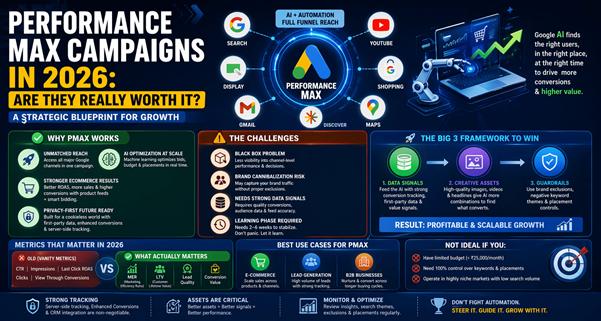
The Big 3 Framework for Winning with Performance Max
1. Build a Strong Conversion Compass
PMax only optimizes toward what you define as success.
Feed better signals.
Use:
- Enhanced conversions
- CRM-qualified lead imports
- Offline conversion tracking
- Value-based bidding
Train the algorithm on revenue, not form fills.
2. Treat Assets Like Performance Drivers
Many advertisers still treat creative as decoration.
That mindset loses.
Winning PMax advertisers treat creative as performance infrastructure.
Use:
- Multiple headlines
- Distinct messaging angles
- Product-focused visuals
- Native-feeling video creatives
Creative is optimization fuel.
3. Use Guardrails, Not Blind Trust
Automation needs boundaries.
Use:
- Brand exclusions
- Negative keyword themes
- Placement exclusions
- Budget controls
The best marketers don’t fight automation.
They steer it.
When Performance Max Is Absolutely Worth It
PMax is often ideal for:
eCommerce Brands
Especially when:
- Product feeds are strong
- Shopping is a growth channel
- ROAS optimization matters
Lead Generation Businesses
If you have enough lead volume and can feed offline quality data back into Google, PMax can perform extremely well.
B2B With Longer Buying Cycles
Cross-channel nurturing makes PMax valuable for B2B demand generation.
When It May Not Be Worth It
Performance Max may not be ideal if:
You Have Very Low Budget
Small budgets may struggle to support learning.
You Need Full Manual Control
If keyword-level control is essential, standard Search may remain better.
Your Tracking Is Broken
Never scale automation on bad data.
Fix measurement first.
Common Myths About Pmax
Myth 1: PMax Replaces Search Campaigns
False.
Often the best structure is:
- Brand Search
- Standard Search
- Performance Max
Hybrid often wins.
Myth 2: Audience Signals Are Targeting
They are learning signals.
Not targeting restrictions.
Big difference.
Myth 3: PMax Runs Itself
Absolutely not.
It still needs:
- Optimization
- Testing
- Creative refreshes
- Feed management
- Strategy
Automation still needs operators.
Final Verdict: Are Performance Max Campaigns Really Worth It?
Yes — when strategically managed, Performance Max can be one of the most powerful campaign types in digital advertising today.
It can deliver:
- Incremental reach
- Better automation
- Stronger efficiency
- Higher-value growth
- Cross-channel scale
But only when supported by:
- Strong tracking
- Good creative
- High-quality signals
- Strategic controls
The marketers winning in 2026 are not asking:
“Should I trust automation?”
They’re asking:
How do I guide automation better than competitors?
That’s the real opportunity.
Want to Master Google Ads, GA4, GTM & Performance Marketing?
At Industry Interface & Life Development Services (IILD), we help learners and professionals build practical expertise in:
- Google Ads & Performance Max
- GA4 and advanced analytics
- Google Tag Manager
- Conversion tracking and server-side tagging
- AI tools for digital marketers
- Real campaig