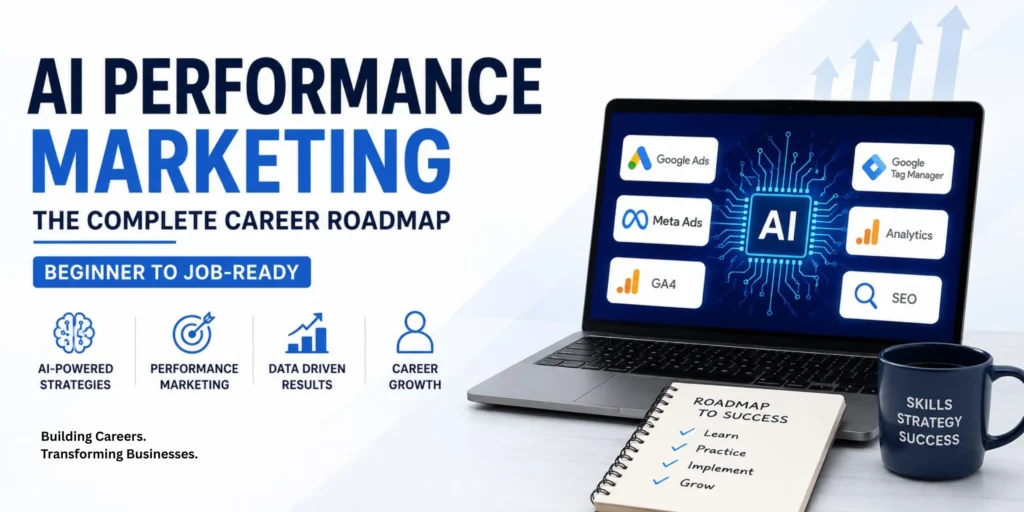
Digital marketing has changed dramatically over the past few years. Artificial Intelligence (AI) is no longer a futuristic concept—it has become an essential part of how businesses plan campaigns, create content, analyze customer behavior, optimize advertising budgets, and improve marketing performance.
However, many aspiring marketers make the mistake of believing that learning AI tools alone will make them successful. In reality, AI is only effective when combined with a strong understanding of marketing strategy, consumer psychology, analytics, advertising platforms, and performance measurement.
This is where AI Performance Marketing stands apart.
It combines the speed and efficiency of AI with data-driven marketing techniques to help businesses generate measurable results. Whether you’re a student preparing for your first marketing job, a professional looking to upgrade your skills, or a business owner aiming to grow your brand, AI Performance Marketing offers a practical path to achieving your goals.
In this comprehensive guide, you’ll learn what AI Performance Marketing is, why it’s becoming one of the most in-demand skills, the tools professionals use, the career opportunities available, and how practical learning can help you become industry-ready.
Table of Contents
- What is AI Performance Marketing?
- Why Traditional Digital Marketing Is No Longer Enough
- Why Businesses Are Investing in AI-Powered Marketing
- Essential Skills Every AI Performance Marketer Needs
- AI Tools Used by Modern Digital Marketers
- The Complete AI Performance Marketing Workflow
- Real-World Campaign Execution Process
- Common Mistakes Beginners Should Avoid
- Career Opportunities in AI Performance Marketing
- Salary Expectations and Industry Demand
- How to Become Job-Ready
- Why Practical Training Makes the Difference
- Frequently Asked Questions
- Final Thoughts
What is AI Performance Marketing?
AI Performance Marketing is a modern approach to digital marketing that combines Artificial Intelligence with performance-based marketing strategies. Instead of relying on assumptions, marketers use real-time data, automation, and machine learning to make informed decisions and continuously improve campaign performance.
Unlike traditional marketing, where success is often measured by visibility alone, performance marketing focuses on measurable outcomes such as:
- Website traffic
- Qualified leads
- Online sales
- Form submissions
- Phone calls
- Return on Ad Spend (ROAS)
- Customer Acquisition Cost (CAC)
- Conversion Rate
AI enhances these efforts by helping marketers:
- Analyze large volumes of marketing data quickly.
- Generate high-quality content and ad copy.
- Identify audience segments more accurately.
- Predict customer behavior.
- Automate repetitive marketing tasks.
- Improve campaign performance through continuous optimization.
The result is a marketing strategy that is faster, smarter, and more efficient.
Why Traditional Digital Marketing Is No Longer Enough
Digital marketing has evolved significantly. While SEO, social media marketing, Google Ads, email marketing, and analytics remain essential, businesses now expect marketers to deliver faster results with greater accuracy.
Several factors have accelerated this shift:
1. Growing Competition
Thousands of businesses compete for the same audience across search engines and social media platforms. Standing out requires smarter strategies backed by data rather than guesswork.
2. Data Is Increasing Rapidly
Modern marketing campaigns generate enormous amounts of information. Website analytics, advertising platforms, CRM systems, and customer interactions all contribute valuable insights. AI helps marketers interpret this data efficiently.
3. Customer Expectations Have Changed
Consumers expect personalized experiences, relevant recommendations, and timely communication. AI enables marketers to deliver personalized content at scale without sacrificing efficiency.
4. Marketing Platforms Continue to Evolve
Google Ads, Meta Ads, LinkedIn Ads, Google Analytics 4 (GA4), and other platforms introduce new features regularly. Professionals who understand both these platforms and AI workflows can adapt more quickly to industry changes.
Why Businesses Are Investing in AI-Powered Marketing
Organizations across industries are incorporating AI into their marketing operations because it helps improve efficiency while maintaining a focus on measurable business outcomes.
Some common applications include:
- Keyword research and content planning
- Ad copy generation
- Audience segmentation
- Marketing automation
- Lead nurturing
- Performance reporting
- Conversion optimization
- Customer journey analysis
- Predictive analytics
However, successful businesses don’t rely on AI alone. They combine AI with experienced marketers who understand strategy, analytics, and business objectives.
AI supports better decisions—it doesn’t replace sound marketing judgment.
Essential Skills Every AI Performance Marketer Needs
A successful AI Performance Marketer requires a balanced combination of technical expertise, analytical thinking, creativity, and business understanding.
Search Engine Optimization (SEO)
Understanding how search engines work remains fundamental. AI can support keyword research, content planning, and optimization, but marketers must still create valuable content that meets user intent.
Performance Advertising
Professionals should be comfortable running campaigns on platforms such as:
- Google Ads
- Meta Ads
- LinkedIn Ads
- YouTube Ads
Knowledge of bidding strategies, campaign structures, audience targeting, and optimization techniques remains essential.
Marketing Analytics
Data-driven decisions depend on accurate tracking. Skills in Google Analytics 4 (GA4), Google Tag Manager (GTM), and conversion tracking help marketers measure results and improve campaign performance.
AI Productivity Tools
Modern marketers use AI to assist with:
- Content creation
- Research
- Campaign planning
- Image generation
- Video scripting
- Workflow automation
The goal is not to replace creativity but to improve productivity and execution speed.
Conversion Rate Optimization (CRO)
Generating traffic is only one part of the equation. AI Performance Marketers also focus on improving landing pages, forms, calls-to-action, and user experience to increase conversions.
AI Tools Used by Professional Marketers
While tools continue to evolve, professionals typically use AI to enhance different stages of the marketing process.
Common categories include:
- AI writing assistants
- AI image generation tools
- AI presentation tools
- AI video creation platforms
- AI meeting assistants
- AI research tools
- AI workflow automation platforms
- AI analytics solutions
The value lies not in using the greatest number of tools, but in selecting the right tool for each task and integrating it into an effective workflow.
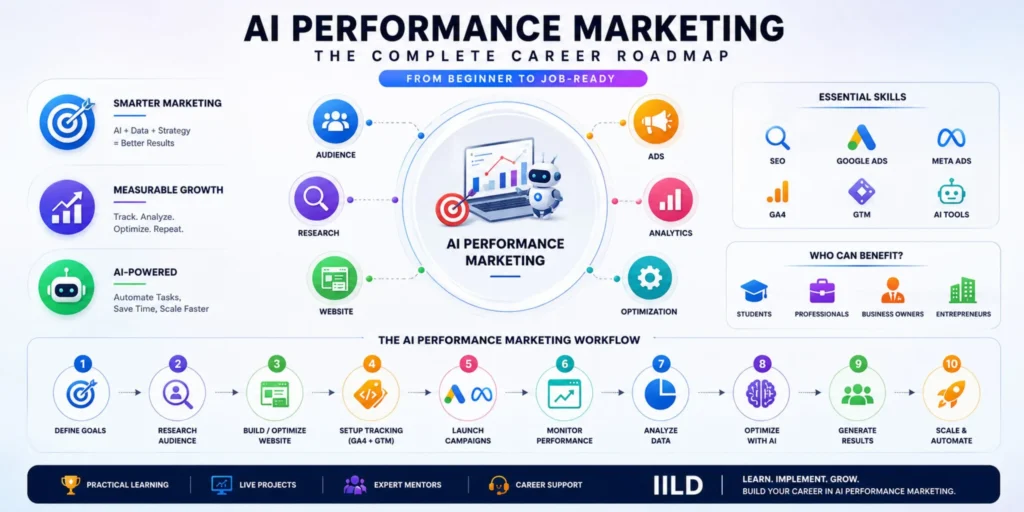
The Complete AI Performance Marketing Workflow
An effective campaign follows a structured process rather than relying on isolated tactics.
- Understand business goals.
- Research the target audience.
- Conduct keyword and competitor analysis.
- Build or optimize the website or landing page.
- Configure GA4, GTM, and conversion tracking.
- Create SEO-focused content.
- Launch Google Ads and Meta Ads campaigns.
- Monitor performance dashboards.
- Analyze conversion data.
- Optimize campaigns continuously using AI insights.
Each stage contributes to measurable business growth and demonstrates why AI-Powered Performance Marketing is more than simply using AI tools.
Conclusion
AI Performance Marketing represents the next stage in the evolution of digital marketing. Organizations are looking for professionals who can combine strategic thinking with practical execution, data analysis, and AI-powered workflows.
Whether you’re beginning your career, expanding your expertise, or growing a business, the most valuable investment is learning how to apply these skills in real-world scenarios.
Success doesn’t come from mastering a single AI tool. It comes from understanding the complete marketing ecosystem—strategy, advertising, analytics, tracking, optimization, and continuous learning.
By developing practical experience alongside AI capabilities, you’ll be better prepared to build campaigns that deliver measurable business results and remain competitive in a rapidly changing digital landscape.