
Introduction
Artificial intelligence has become a core part of modern performance marketing. Marketers now use ChatGPT, Gemini, Claude, Copilot, Perplexity, and automation tools like n8n for campaign planning, SEO research, ad copy creation, analytics interpretation, reporting, and workflow automation.
Yet many marketers still struggle with one critical skill: prompt engineering.
The difference between an average AI output and a high-performing marketing output is usually not the tool — it’s the quality of the prompt.
A vague prompt such as “Write Google Ads copy” produces generic results. A structured prompt that includes business context, audience, objective, offer, platform constraints, and success criteria produces outputs that are far more usable — often on the first try.
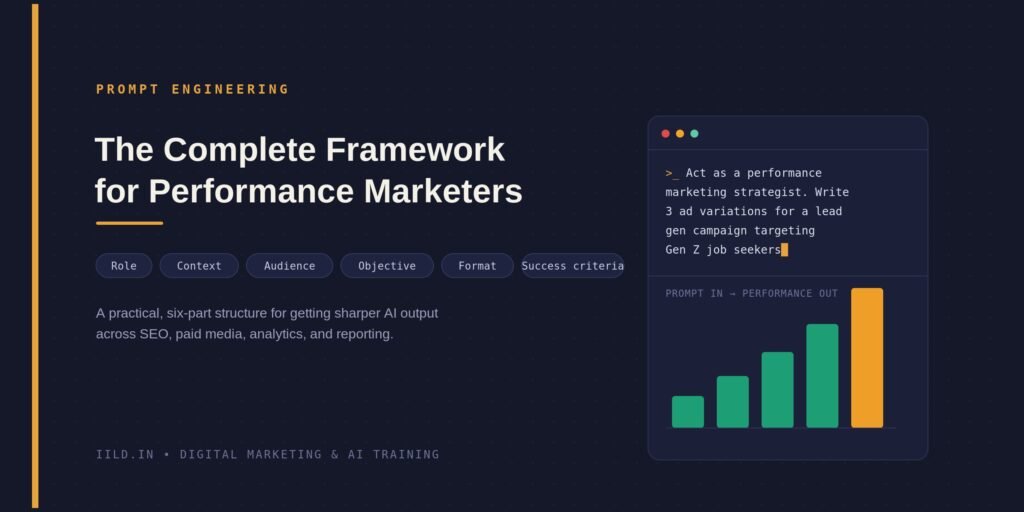
This article breaks down a practical, six-part prompt engineering framework built for performance marketers, applicable across SEO, paid media, analytics, email marketing, content marketing, reporting, and automation workflows.
Why Prompt Engineering Matters in Performance Marketing
Performance marketing is outcome-driven. Every campaign is judged against hard metrics:
- Click-through rate (CTR)
- Conversion rate
- Cost per acquisition (CPA)
- Return on ad spend (ROAS)
- Lead quality
- Revenue contribution
AI can move these numbers — but only when it receives precise instructions. The model has no visibility into your brand, your funnel, or your last campaign’s performance unless you put it in the prompt.
Poor prompt:
“Create Facebook ad copy.”
Better prompt:
“You are a performance marketing copywriter. Create 3 Meta ad variations for a digital marketing AI course targeting fresh graduates in India aged 21–30. Goal: lead generation. Highlight AI tools, live projects, and career support. Keep primary text under 90 words and include a strong CTA.”
The second prompt gives the AI a clear role, audience, objective, key selling points, and format constraints — which is exactly why it performs better.
The Complete Framework: Six Parts
Every high-performing prompt for performance marketing tasks should include these six elements.
1. Role
Tell the AI who it should act as. This shapes tone, vocabulary, and the level of strategic judgment in the response.
“Act as a senior performance marketing strategist with 10 years of experience in D2C e-commerce.”
Without a role, the model defaults to a neutral, generic voice — rarely what a brand or campaign actually needs.
2. Context
Give the AI the business and campaign background it has no way of knowing on its own: the product or service, the industry, the current stage of the funnel, past performance, and any constraints.
“We sell an online digital marketing certification course. Our current CPA on Meta is ₹850, and we want to bring it down to ₹600 without losing lead quality.”
Context is what turns a generic answer into one grounded in your actual business reality.
3. Audience
Define exactly who the output is for — demographics, intent, funnel stage, and emotional drivers. “Everyone” is not an audience.
“Target audience: working professionals aged 25–35 in Tier 1 Indian cities, currently in non-marketing roles, considering a career switch into digital marketing.”
4. Objective
State the specific goal of the task — awareness, leads, conversions, retention, or a specific metric to improve. A single, clear objective keeps the output focused instead of trying to do everything at once.
“Objective: generate qualified leads for a free webinar, optimized for cost per registration.”
5. Format
Specify exactly how the output should be structured — character limits, number of variations, platform-specific rules, or table/report layout. This is the difference between an output you can use immediately and one you have to rework by hand.
“Provide 5 headline variations (max 30 characters each) and 3 descriptions (max 90 characters each), formatted for Google Responsive Search Ads.”
6. Success Criteria
Tell the AI what “good” looks like — the tone, the constraints it must respect, and what to avoid. This is where you encode brand guidelines and platform policy directly into the prompt.
“Avoid generic phrases like ‘unlock your potential.’ Tone should be direct and confident, not salesy. Must comply with Google Ads editorial policies.”
Put together, these six elements form a single structured prompt:
“Role: Act as a senior performance marketing copywriter. Context: We run a digital marketing AI course for career switchers in India. Audience: Fresh graduates aged 21–30 actively job-hunting. Objective: Drive lead generation through Meta Ads. Format: 3 primary text variations, under 90 words each, with a clear CTA. Success criteria: Highlight AI tools, live projects, and career support; tone should be motivating but credible, not hypey.”
Applying the Framework Across Marketing Functions
SEO & Content Research
“Act as an SEO strategist. For the keyword ‘digital marketing course in India,’ identify 5 related long-tail keywords, current search intent, and 3 content gaps our competitors haven’t addressed. Present as a table.”
Analytics & Reporting
“Act as a GA4 analyst. Here is last month’s traffic and conversion summary: [paste data]. Identify the top 3 trends, flag any anomalies, and suggest 2 hypotheses for the drop in conversion rate on mobile traffic.”
Email Marketing
“Act as an email marketing specialist. Write a 3-email nurture sequence for leads who downloaded our free digital marketing guide but haven’t booked a demo. Goal: move them to book a call. Tone: helpful, not pushy.”
Campaign Automation (n8n / Zapier workflows)
“Act as a marketing automation consultant. Outline a workflow that automatically tags a lead as ‘hot’ in our CRM when they visit the pricing page twice within 48 hours, and triggers a follow-up WhatsApp message.”
Common Mistakes to Avoid
- Skipping the role. Without it, output tone stays flat and generic.
- Vague objectives. “Improve marketing” isn’t a task; “reduce CPA on the lead gen campaign by 20%” is.
- No format constraints. Platform character limits and structure rules need to be in the prompt, not fixed afterward.
- One-shot thinking. Treat the first output as a draft. Refine with follow-ups — “make this more urgent,” “shorten to fit the character limit” — rather than starting over each time.
- Feeding in messy, unlabeled data. Structure your inputs (labeled numbers, clear date ranges) so the model can actually reason over them instead of guessing.
Building a Reusable Prompt Library
The highest-leverage move for any performance marketing team isn’t writing one great prompt — it’s saving the good ones. Build a shared library of tested prompt templates for ad copy, reporting, SEO research, and campaign audits, each with placeholders for the variables that change (product, audience, platform, budget, funnel stage). This turns prompt engineering from a one-off skill into a repeatable team asset — the same way a swipe file or a creative brief template works.
Final Thoughts
Prompt engineering isn’t about tricking an AI model into better answers — it’s about giving it the same clarity and structure you’d put into a proper campaign brief. Performance marketers who consistently apply the Role–Context–Audience–Objective–Format–Success Criteria framework will get more accurate, more usable, and more strategically sound outputs from AI tools — turning them from a novelty into a genuine performance lever.