Introduction
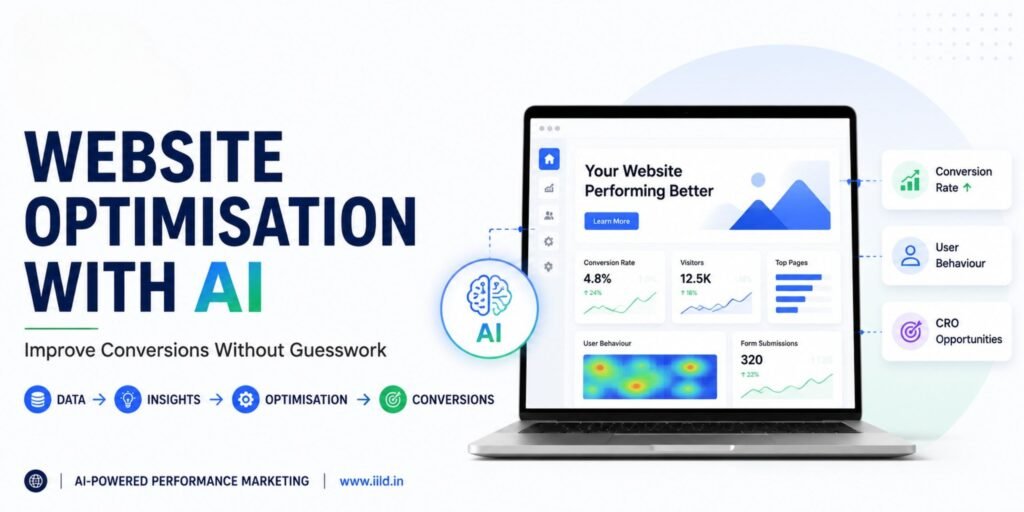
Getting more traffic to a website does not automatically mean getting more customers.
A website can attract thousands of visitors and still generate disappointing leads or sales if users cannot quickly understand the offer, trust the business, or complete the desired action.
This is where Conversion Rate Optimisation (CRO) becomes important.
Traditionally, website optimisation involved manually reviewing analytics, studying user behaviour, creating hypotheses, testing different versions, and waiting for enough data to make decisions. The process still works, but AI can make it significantly faster and more systematic.
With tools such as ChatGPT, Claude, Gemini, Microsoft Copilot, GA4, Google Tag Manager, Microsoft Clarity, Hotjar, and AI-powered automation using n8n or Make, marketers can identify problems, analyse data, generate optimisation ideas, and prioritise experiments more efficiently.
The objective is not to let AI randomly redesign a website.
The objective is to use real user and business data to make better optimisation decisions.
What Is Website Optimisation?
Website optimisation is the process of improving a website so that it performs better against specific business objectives.
Depending on the business, that objective could be:
- Generating more qualified leads
- Increasing product purchases
- Improving demo bookings
- Increasing form submissions
- Reducing cart abandonment
- Increasing newsletter sign-ups
- Improving engagement
- Increasing landing-page conversion rates
A simple way to think about CRO is:
Traffic → User Experience → Action → Conversion
If traffic is increasing but conversions are not, the problem may not be traffic acquisition.
It may be the website.
Why More Traffic Doesn’t Always Solve the Problem
Imagine two websites receive 10,000 visitors per month.
Website A
- 10,000 visitors
- 500 leads
- 5% conversion rate
Website B
- 10,000 visitors
- 150 leads
- 1.5% conversion rate
Both websites have the same amount of traffic, but Website A generates more than three times as many leads.
This is why marketers should not evaluate website performance using traffic alone.
Instead, they should examine:
- Conversion rate
- Landing-page performance
- User behaviour
- CTA performance
- Form completion
- Drop-off points
- Device performance
- Traffic-source quality
- Page speed
- User intent
- Funnel progression
AI can help analyse these signals faster, but the quality of the underlying data still matters.
How AI Changes Website Optimisation
AI does not replace CRO strategy.
It accelerates the research, analysis, ideation, and execution involved in CRO.
A traditional workflow might look like:
Collect Data → Analyse Data → Find Problems → Create Hypothesis → Test → Measure
An AI-assisted workflow can become:
Track → Collect → Analyse with AI → Prioritise → Create Variations → Test → Measure → Automate Reporting
This creates a more continuous optimisation process.
1. Use AI to Analyse Website Performance
The first step should be understanding what is actually happening.
Tools such as Google Analytics 4 (GA4) can provide information about:
- Landing pages
- Traffic sources
- User engagement
- Events
- Key events
- Conversions
- Device performance
- User journeys
Instead of manually scanning large amounts of data, marketers can use AI tools such as ChatGPT, Claude, Gemini, or Copilot to help organise and interpret datasets.
For example, a marketer could provide a campaign performance report and ask AI to identify:
Which landing pages have high traffic but unusually low conversion rates?
The AI can help surface patterns that deserve investigation.
However, there is an important limitation:
AI should not be treated as the source of truth.
GA4, CRM, advertising platforms, and website tracking systems remain the sources of actual performance data.
AI should help interpret the evidence—not invent it.
2. Analyse User Behaviour, Not Just Numbers
Analytics tells you what happened.
Behaviour-analysis tools can help investigate how users interacted with the website.
Tools such as Microsoft Clarity and Hotjar can provide behavioural signals including:
- Session recordings
- Heatmaps
- Scroll behaviour
- Rage clicks
- Dead clicks
- User friction
- Form behaviour
Suppose GA4 shows that a landing page has a high bounce rate.
That is a problem signal.
But the number alone does not explain why users are leaving.
Session recordings and heatmaps may reveal that:
- The CTA is difficult to find.
- Important information appears too late.
- Users are clicking an element that is not interactive.
- The form is too long.
- Mobile users encounter layout problems.
AI can then help organise these observations into potential hypotheses.
3. Improve Landing Pages with AI
Landing pages have one primary job:
Move the right visitor toward the intended action.
AI can help marketers evaluate landing-page elements such as:
Headlines
Does the headline clearly communicate the value proposition?
Subheadings
Does the supporting copy explain the offer without creating unnecessary complexity?
CTA
Is the CTA specific and action-oriented?
Trust Signals
Does the page provide enough evidence to reduce uncertainty?
Examples include:
- Reviews
- Testimonials
- Case studies
- Certifications
- Client logos
- Results
- Guarantees
- Security information
Page Structure
Does the visitor encounter the most important information in the right order?
AI tools can generate alternative copy and structures, but marketers should not publish every AI-generated suggestion.
The correct approach is:
AI generates hypotheses → marketer evaluates them → users provide behavioural evidence → experiments validate them.
4. Use AI for Conversion Copywriting
Website copy has a direct impact on conversion behaviour.
AI tools such as ChatGPT, Claude, Gemini, and Copilot can help generate variations for:
- Headlines
- CTA buttons
- Product descriptions
- Landing-page copy
- Benefit statements
- FAQs
- Error messages
- Ad-to-landing-page messaging
- Form microcopy
For example, instead of simply using:
“Submit”
a marketer might test:
- Get My Free Consultation
- Book a Strategy Call
- Request a Demo
- Get the Full Report
The important point is that AI-generated copy is not automatically better copy.
The winning version should be determined through testing and conversion data.
5. Optimise Forms with AI and Analytics
Forms are often one of the biggest conversion barriers.
A form asking for:
- Name
- Phone
- Company
- Job Title
- Website
- Budget
- Industry
- Message
- Location
may collect more information, but it can also create more friction.
Marketers should determine which fields are genuinely necessary.
AI can help analyse historical lead data and identify patterns such as:
- Which fields are frequently abandoned
- Which fields correlate with qualified leads
- Which questions create unnecessary friction
- Which form variations perform better
The goal isn’t simply to create a shorter form.
The goal is to find the right balance between conversion rate and lead quality.
6. Improve Tracking Before Optimising
One of the biggest CRO mistakes is optimising a website without reliable tracking.
Before making major changes, marketers should establish a clear measurement framework.
A typical setup may include:
Website → DataLayer → Google Tag Manager → GA4 → Ads Platforms → Reporting
Important events might include:
page_viewclickform_startform_submitgenerate_leadadd_to_cartbegin_checkoutpurchase
For lead-generation websites, marketers should also connect website conversions with CRM outcomes wherever possible.
Otherwise, a campaign may appear successful because it generates many conversions while actually producing poor-quality leads.
7. Use AI to Find Conversion Opportunities
Once reliable data is available, AI can help prioritise optimisation opportunities.
For example:
| Problem | Possible AI-Assisted Action |
| High traffic + low conversions | Analyse landing-page friction |
| High form starts + low submissions | Investigate form abandonment |
| High mobile drop-off | Analyse mobile UX |
| High CTA clicks + low completion | Review post-click experience |
| High traffic + low engagement | Review content-intent alignment |
| High cart abandonment | Investigate checkout friction |
This creates a more structured CRO process.
Instead of asking:
“What should we change?”
ask:
“Which evidence-backed problem should we solve first?”
8. Build AI-Assisted CRO Workflows
AI becomes significantly more useful when connected to automation.
Platforms such as n8n and Make can connect analytics, spreadsheets, CRMs, reporting systems, and AI models.
For example:
GA4 Data → Automation → AI Analysis → CRO Insight → Marketing Report
A workflow could automatically:
- Collect weekly website performance data.
- Compare it against previous periods.
- Identify unusual changes.
- Ask an AI model to summarise possible causes.
- Categorise issues by priority.
- Add findings to a reporting sheet.
- Send the summary to the marketing team.
This reduces repetitive reporting work.
The marketer can then spend more time on strategy, experimentation, and decision-making.
9. Don’t Let AI Optimise for the Wrong Metric
This is where many AI-driven optimisation strategies fail.
Suppose AI identifies that changing a CTA from:
“Book a Consultation”
to:
“Get Started Now”
increases clicks.
That sounds positive.
But what happens if qualified leads decrease?
The optimisation was actually harmful.
CRO should therefore consider the entire funnel:
Click → Lead → Qualified Lead → Opportunity → Customer → Revenue
The best-performing website is not necessarily the one with the highest click-through rate.
It is the one that contributes to the business outcome.
10. A/B Testing Still Matters
AI can generate dozens of ideas in seconds.
That does not mean all of them should be implemented.
Testing remains critical.
A basic A/B testing process looks like:
Step 1: Identify a problem
Example:
Product page traffic is strong, but purchase conversion is low.
Step 2: Create a hypothesis
Adding clearer product benefits and trust signals above the CTA may increase purchases.
Step 3: Create a variation
Use AI to help develop the alternative copy or layout.
Step 4: Run the test
Compare the original and variation.
Step 5: Measure the right outcome
Look beyond clicks.
Measure:
- Conversion rate
- Revenue
- Lead quality
- Average order value
- Downstream business results
Step 6: Document the learning
Even a failed test can provide valuable information.
AI Tools That Can Support Website CRO
A practical AI-assisted CRO stack could include:
AI Research & Analysis
- ChatGPT
- Claude
- Gemini
- Microsoft Copilot
- Perplexity
Analytics & Tracking
- GA4
- Google Tag Manager
- Looker Studio
Behaviour Analysis
- Microsoft Clarity
- Hotjar
Automation
- n8n
- Make
Testing & Optimisation
- A/B testing platforms
- Landing-page testing tools
- Experimentation frameworks
The important thing is not how many tools you use.
A complicated stack with poor tracking is worse than a simple stack with reliable data.
A Practical AI-Powered Website Optimisation Framework
You can structure your CRO process around six stages:
1. Track
Make sure important user actions are properly measured.
2. Analyse
Use GA4, behaviour tools, CRM data, and advertising data to understand performance.
3. Diagnose
Identify where users are dropping out and investigate why.
4. Prioritise
Rank opportunities based on:
Impact × Confidence × Ease
5. Experiment
Use AI to generate variations, then validate them through controlled testing.
6. Learn
Document what worked, what failed, and what should be tested next.
This turns website optimisation into a repeatable process rather than a collection of random design changes.
Common AI CRO Mistakes to Avoid
1. Making changes based only on AI recommendations
AI can identify patterns and generate hypotheses, but it does not know your business as well as your data and experienced marketing team.
2. Optimising for clicks instead of revenue
More clicks do not necessarily mean more customers.
3. Ignoring tracking quality
Poor event tracking produces poor optimisation decisions.
4. Making too many changes simultaneously
If you change the headline, CTA, pricing, layout, form, images, and navigation at the same time, it becomes difficult to understand what actually influenced the result.
5. Copying competitors
A competitor’s website may work for their audience, positioning, pricing, and brand.
That doesn’t mean it will work for yours.
6. Assuming AI-generated content converts better
AI can produce polished copy quickly.
Only real user behaviour can tell you whether that copy works.
The Future of Website Optimisation Is AI-Assisted, Not AI-Controlled
AI is changing how performance marketers approach website optimisation.
It can analyse large datasets, identify patterns, generate copy variations, support research, automate reports, and accelerate experimentation.
But the fundamental CRO principle remains unchanged:
Understand the user. Measure the behaviour. Form a hypothesis. Test it. Learn from the result.
The biggest opportunity is therefore not replacing CRO specialists with AI.
It is giving marketers better tools to make decisions faster.
A strong AI-powered CRO workflow might look like:
GA4 + GTM → Behaviour Data → AI Analysis → CRO Hypothesis → Experiment → Conversion Data → Business Results
That is how AI can help websites improve without guesswork.
Conclusion
Website optimisation should never be a guessing game.
Increasing traffic without improving the conversion experience can simply send more people into the same leaky funnel. AI provides marketers with a way to analyse performance faster, uncover potential friction points, generate optimisation ideas, and automate repetitive CRO workflows.
But AI should remain part of the decision-making system—not the decision-maker.
Use ChatGPT, Claude, Gemini, Copilot, GA4, GTM, Clarity, Hotjar, n8n, and Make where they genuinely improve the workflow. Combine those tools with accurate tracking, customer understanding, experimentation, and business metrics.
The result is a more disciplined approach to CRO:Less guessing. More evidence. Better experiments. Stronger conversions.