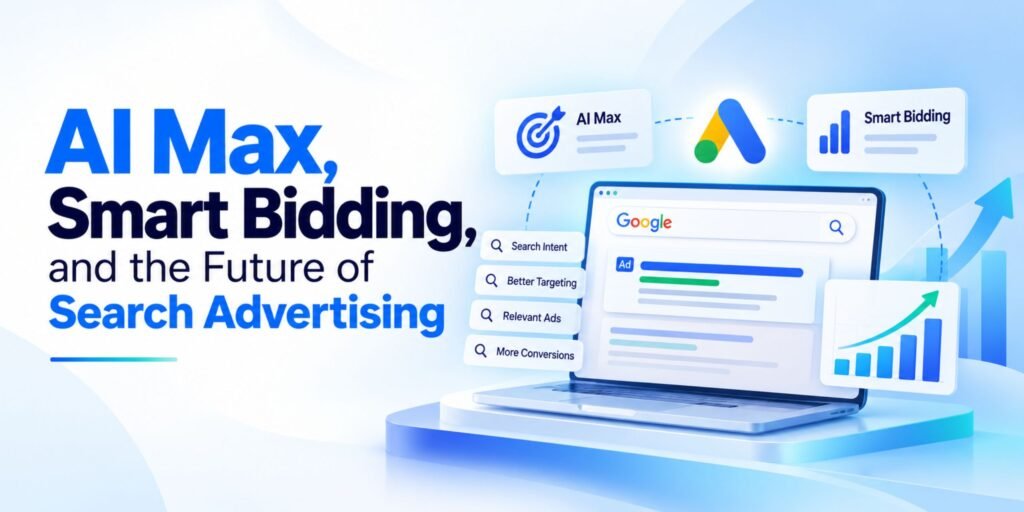
Search advertising is moving away from a model where marketers manually control every keyword, bid, ad variation, and landing-page decision.
Google Ads is increasingly using AI to interpret search intent, match users with relevant ads, adjust bids at auction time, and optimize creative and landing-page experiences. Two important parts of this shift are AI Max for Search campaigns and Smart Bidding.
For performance marketers, this does not mean strategy is disappearing. It means the role of the marketer is changing—from manually controlling every auction to building the right inputs, conversion signals, campaign structure, and business objectives for AI to optimize against.
This article explains how AI Max and Smart Bidding work, what is changing in Search advertising, and what marketers should focus on as Google Search becomes increasingly AI-driven.
What Is AI Max for Search Campaigns?
AI Max is not a separate campaign type. Google describes it as an optimization layer within existing Search campaigns that uses AI for targeting and creative optimization.
Its purpose is to help Search campaigns discover relevant opportunities beyond traditional keyword-based targeting while using additional signals to optimize ad delivery.
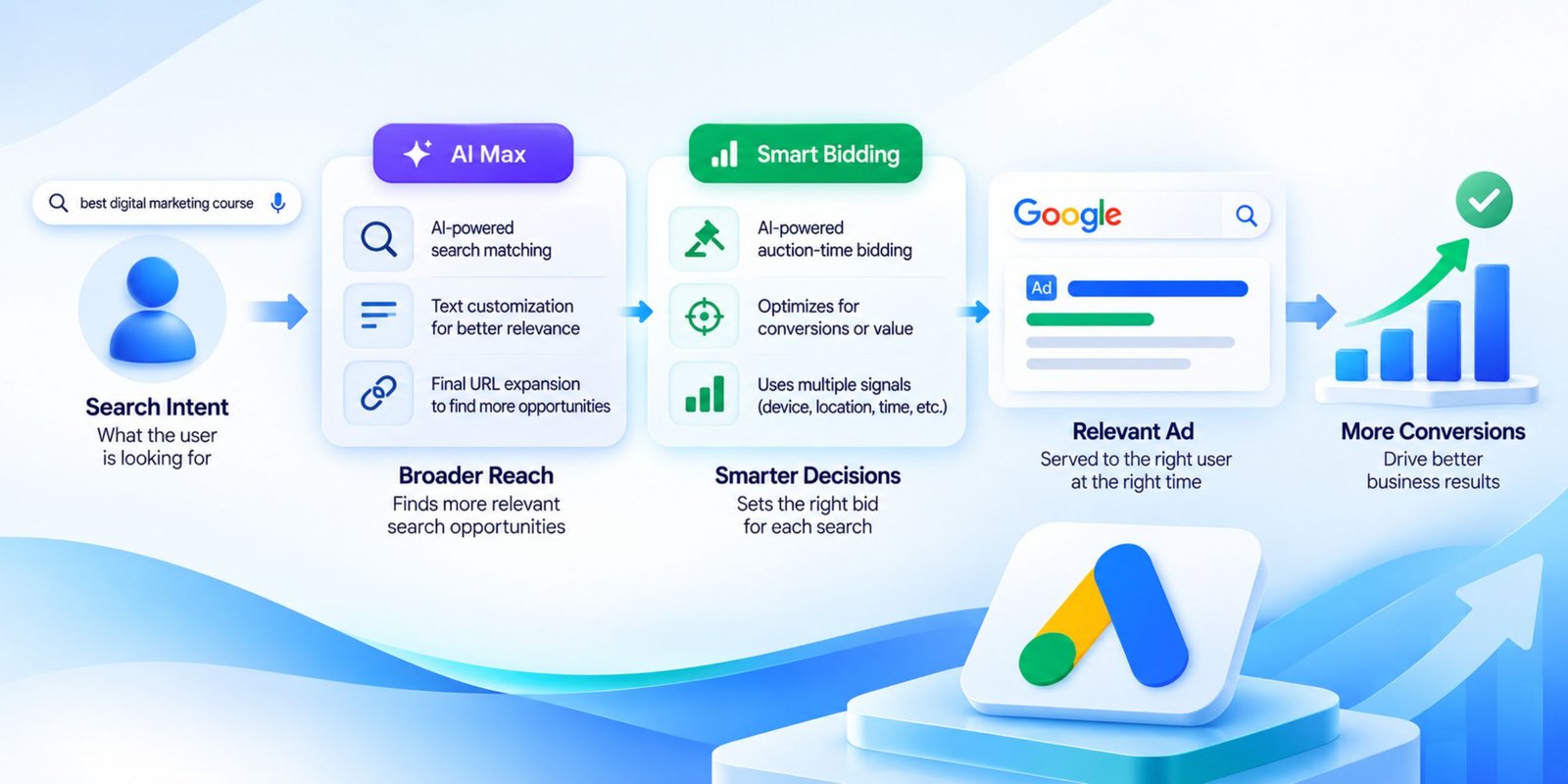
AI Max currently brings together capabilities such as:
- AI-powered search term matching
- Text customization
- Final URL expansion
- Additional brand and location controls
- More detailed reporting around search journeys and assets
Google says search term matching can use broad-match and keywordless technology to identify relevant queries based on existing keywords, creatives, and URLs.
This represents an important change in how marketers think about Search.
Instead of asking only:
“Which keyword should trigger this ad?”
the system increasingly asks:
“What does this person appear to be trying to accomplish, and which combination of targeting, creative, landing page, and bid is most relevant?”
From Keywords to Intent
Traditional Search advertising has historically revolved around keywords.
A marketer might build a structure such as:
Keyword → Ad → Landing Page → Conversion
AI-powered Search increasingly adds more context:
Search Intent + Signals + Creative + Landing Page + Conversion Data → AI Optimization
This does not make keywords irrelevant. Rather, keywords become one part of a broader system for understanding intent.
Google’s AI Max documentation says its search term matching can expand beyond existing keywords to find relevant searches and conversions that advertisers might otherwise miss.
For marketers, this creates an important responsibility:
The better your inputs, the more useful the automation can become.
What Is Smart Bidding?
Smart Bidding is Google’s collection of AI-powered bidding strategies that optimize for conversions or conversion value at auction time. Google currently identifies Target CPA, Target ROAS, Maximize Conversions, and Maximize Conversion Value as Smart Bidding strategies.
Instead of manually deciding how much to bid for every search, Smart Bidding evaluates contextual information and predicts the likelihood or value of a conversion.
Google explains that its systems consider signals such as:
- Device
- Location
- Time
- Browser
- Operating system
- Language
- Remarketing information
- Search-query-level performance
- Combinations of contextual signals
The bid can then be adjusted for the individual auction.
This is why manual bid management becomes less central as automated bidding improves.
The marketer’s job shifts toward defining what counts as success.
AI Max and Smart Bidding Do Different Jobs
One of the easiest mistakes is treating AI Max and Smart Bidding as the same technology.
They solve different parts of the Search advertising problem.
| Area | AI Max | Smart Bidding |
| Primary role | Targeting & creative optimization | Bid optimization |
| Focus | Finding and serving relevant opportunities | Deciding auction-level bids |
| Search matching | Yes | Uses search/query signals |
| Creative optimization | Yes | Not its primary role |
| Auction-time bidding | Not its primary function | Yes |
| Conversion signals | Important | Fundamental |
| Business objective | Influences optimization inputs | Directly optimized through bidding |
A simplified Search workflow looks like this:
Search Intent → AI Max → Relevant Opportunity → Smart Bidding → Auction Bid → Ad → Landing Page → Conversion
The two systems can therefore work together rather than being viewed as competing approaches.
Why Conversion Tracking Is Becoming More Important
AI-powered advertising depends heavily on conversion information.
Imagine two campaigns.
Campaign A
The account tracks:
- Page views
- Button clicks
- Form starts
- Qualified leads
- Revenue
But the campaign optimizes primarily toward a low-value micro-conversion.
Campaign B
The account tracks:
- Qualified leads
- Sales
- Revenue value
And the conversion goals are aligned with the actual business objective.
The systems in both campaigns can optimize efficiently against the signals they receive—but the business value of those signals may be very different.
Google specifically recommends using accurate conversion data and campaign objectives when setting up Smart Bidding.
This leads to an important principle:
AI cannot compensate for a badly defined conversion goal.
If your tracking is wrong, your AI optimization can become highly efficient at pursuing the wrong outcome.
Target CPA and Target ROAS Are Still About Business Goals
Google’s Smart Bidding strategies can optimize around either conversion volume or conversion value.
Conversion-focused bidding
Maximize Conversions aims to generate as many conversions as possible within the available budget.
Target CPA adds a target cost per acquisition to that objective.
Value-focused bidding
Maximize Conversion Value focuses on generating conversion value.
Target ROAS adds a return-on-ad-spend target to the optimization.
This distinction matters.
A business selling products with significantly different order values may care more about revenue value than simply counting purchases.
Similarly, a lead-generation business may need to distinguish between:
Lead → Qualified Lead → Opportunity → Customer
rather than treating every form submission as equally valuable.
Google’s 2026 Smart Bidding Naming Changes
Google is also simplifying the naming of target-based Smart Bidding strategies.
Starting in June 2026, Google began transitioning the interface so that:
- “Maximize conversions with a Target CPA” becomes Target CPA
- “Maximize conversion value with a Target ROAS” becomes Target ROAS
Google states that this is a naming and interface change and does not change the underlying bidding behavior of those strategies.
For marketers, the important point is not the label itself.
The important point is understanding what the bidding system is being asked to optimize.
AI Max Is Changing the Role of Keywords
For years, Search marketers were trained to think deeply about:
- Exact match
- Phrase match
- Broad match
- Negative keywords
- Keyword grouping
- Search terms
These skills remain useful, but AI Max increases the importance of understanding intent and signals.
Google says AI Max search term matching can use existing keywords, creatives, and URLs to identify relevant searches beyond the advertiser’s original keyword set.
That means marketers should increasingly evaluate campaigns through questions such as:
- What types of searches are we attracting?
- Are those searches commercially relevant?
- Are our conversion signals accurate?
- Which search themes generate qualified outcomes?
- Does the landing page actually satisfy the intent?
- Are we giving Google’s systems enough useful information to learn from?
The marketer becomes less of a keyword controller and more of a system designer.
AI Max Is Not a Replacement for Strategy
Automation can expand reach and make optimization more sophisticated.
But automation does not automatically create:
- A strong offer
- A good landing page
- Accurate conversion tracking
- Clear positioning
- High-quality creative
- A compelling customer journey
- A sensible business objective
Google’s own AI Max documentation notes that AI Max may not be effective when campaigns are limited by budget.
This is a useful reminder that AI optimization operates within the conditions of the campaign.
If the fundamentals are weak, adding more automation does not necessarily solve the underlying problem.
A useful framework is:
Business Goal
↓
Marketing Objective
↓
Conversion Definition
↓
Tracking & Data Quality
↓
Campaign Structure
↓
AI Optimization
↓
Human Analysis
AI sits inside the system—not above it.
The Shift From Manual Optimization to Signal Management
Performance marketers used to spend significant time making manual decisions such as:
- Increasing bids
- Decreasing bids
- Adjusting device bids
- Changing keyword targeting
- Reviewing search terms
- Testing ad variations
- Moving budgets between campaigns
Automation can now perform many of these activities at much greater scale.
The strategic work increasingly becomes:
1. Define the objective
What does the business actually want?
Revenue? Qualified leads? Purchases? Profit?
2. Define the conversion
What event represents meaningful progress?
3. Improve tracking
Use tools such as:
- Google Tag Manager
- Google Analytics 4
- Google Ads conversion tracking
- CRM data
4. Improve inputs
Provide relevant:
- Keywords
- Landing pages
- Ad assets
- Conversion signals
- Audience/context signals
5. Evaluate outcomes
Do not stop at:
CTR → CPC → Conversions
Look further:
Conversion → Qualified Lead → Sale → Revenue → Business Value
The Future of Search Advertising Will Be More AI-Driven
Google’s direction is increasingly clear: Search advertising is moving toward systems that can understand more context and automate more decisions.
AI Max is part of that transition.
Google announced in April 2026 that AI Max was moving out of beta and that certain legacy Search configurations would be upgraded to AI Max. The company later updated the timeline for Dynamic Search Ads, saying the DSA sunset and auto-upgrade would begin in February 2027, while campaigns using Automatically Created Assets and the campaign-level broad match setting would continue to be auto-upgraded starting in September 2026.
This means Search marketers should not build their long-term skills around a single interface or a fixed set of manual controls.
They need to understand the system underneath the interface.
What Performance Marketers Should Learn Now
The future of Search advertising requires a broader skill stack.
1. Search Intent
Understand why someone searches—not just what keyword they typed.
2. Conversion Tracking
Learn how GTM, GA4 and Google Ads work together.
3. Data Quality
Understand whether the signals being sent to advertising platforms are accurate and useful.
4. Landing-Page Optimization
AI can help find opportunities, but the landing page still has to deliver the experience.
5. Smart Bidding
Understand the difference between:
Maximize Conversions
Target CPA
Maximize Conversion Value
Target ROAS
and when business objectives call for each approach.
6. AI Max
Understand search term matching, asset optimization, URL expansion and the controls available to guide automation.
7. Business Analytics
Move beyond platform metrics and connect advertising performance to actual business outcomes.
8. AI-Assisted Analysis
AI tools such as ChatGPT, Claude and Gemini can help marketers analyze reports, identify patterns, generate hypotheses, document workflows and prepare optimization ideas.
The important skill is not simply knowing the tools.
It is knowing what question to ask them.
What AI Will Not Remove From Performance Marketing
AI can automate many execution tasks.
But performance marketers still need to answer questions such as:
Is this the right audience?
Is the offer competitive?
Is this conversion actually valuable?
Why are leads not becoming customers?
Is the landing page aligned with search intent?
Is the campaign generating business value?
Should we scale, fix, test, or stop?
These are strategic questions.
The future marketer therefore needs less obsession with manually controlling every setting and more capability in measurement, diagnosis, experimentation and decision-making.
A Practical AI-Ready Search Framework
Before enabling or expanding AI-powered Search features, audit these seven areas:
Business
What outcome matters?
Offer
Why should the customer choose you?
Intent
Which customer problems are you targeting?
Tracking
Are conversions being measured correctly?
Data
Are the signals meaningful and reliable?
Campaign
Is the structure aligned with the objective?
Optimization
What should AI optimize—and what should humans review?
This creates a simple principle:
Better inputs → Better signals → Better optimization decisions.
Final Thoughts
AI Max and Smart Bidding represent a significant evolution in Search advertising, but they do not eliminate the need for skilled performance marketers.
They change where that skill is applied.
The marketer of the future may spend less time manually adjusting individual bids and more time designing the system that those algorithms operate within.
That means understanding:
Search Intent + Conversion Tracking + GA4 + GTM + Smart Bidding + AI Max + Landing Pages + Business Data + Human Judgment
The competitive advantage will not simply belong to the marketer who knows the most Google Ads buttons.
It will increasingly belong to the marketer who can define the right objective, provide reliable signals, understand AI-driven optimization, and connect advertising data to real business outcomes.AI can optimize the campaign.
The marketer still has to define what success means.