Meta Ads AI Connectors enable marketers to create, manage, optimize, and analyze campaigns using AI tools. Discover how this shift is transforming performance marketing, tracking, and digital skills.
Introduction: AI in Marketing Is Evolving Fast
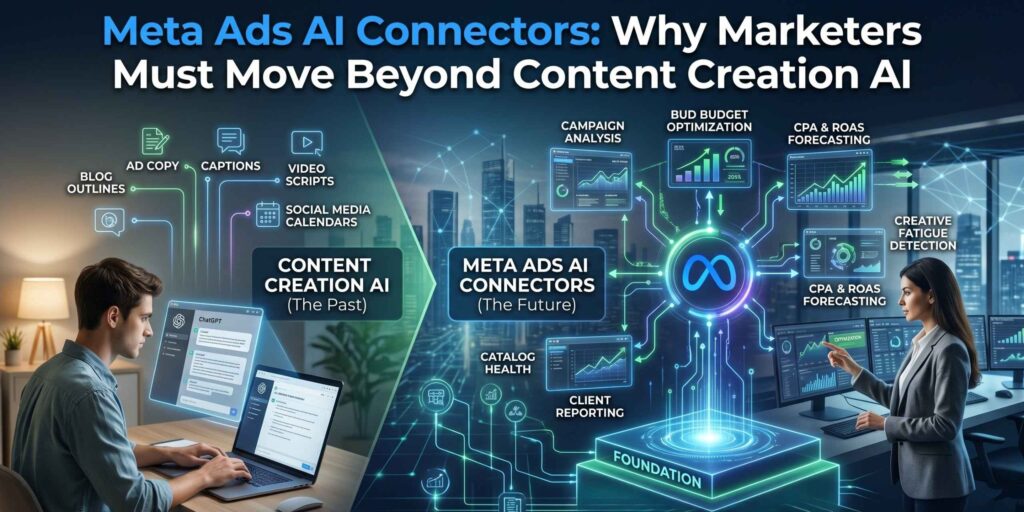
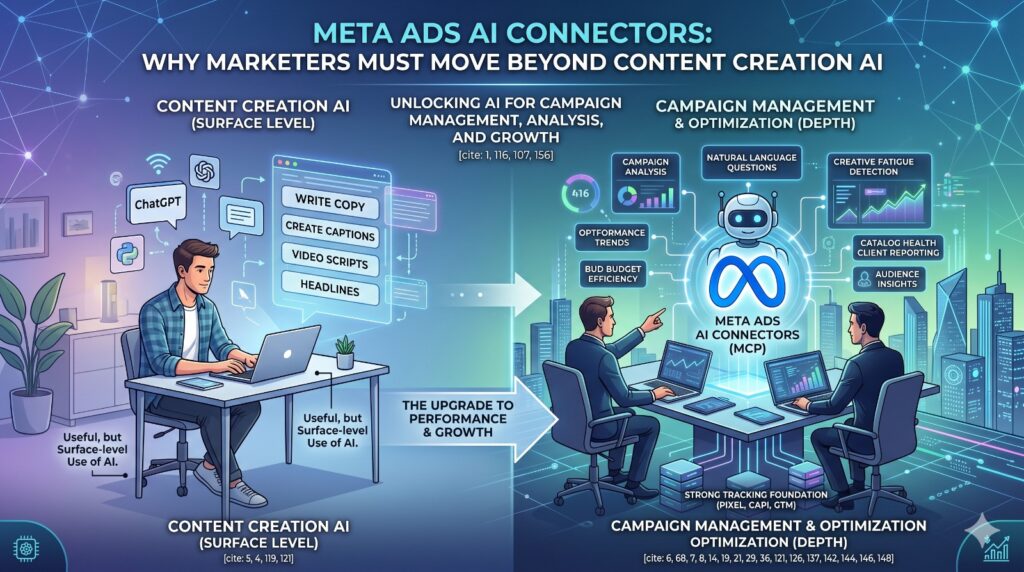
For years, AI in digital marketing has been largely limited to content creation. Tools like ChatGPT, Claude, and Google Gemini have helped marketers generate ad copy, captions, scripts, and blog content at scale.
While this improved productivity, it only scratched the surface.
Now, Meta is pushing AI into the core of campaign execution with Meta Ads AI Connectors. This marks a shift from “content-level AI” to “performance-level AI.”
What Are Meta Ads AI Connectors?
Meta Ads AI Connectors allow marketers to interact with campaigns using natural language instead of manual dashboards.
In simple terms, instead of clicking through Ads Manager, you can ask AI:
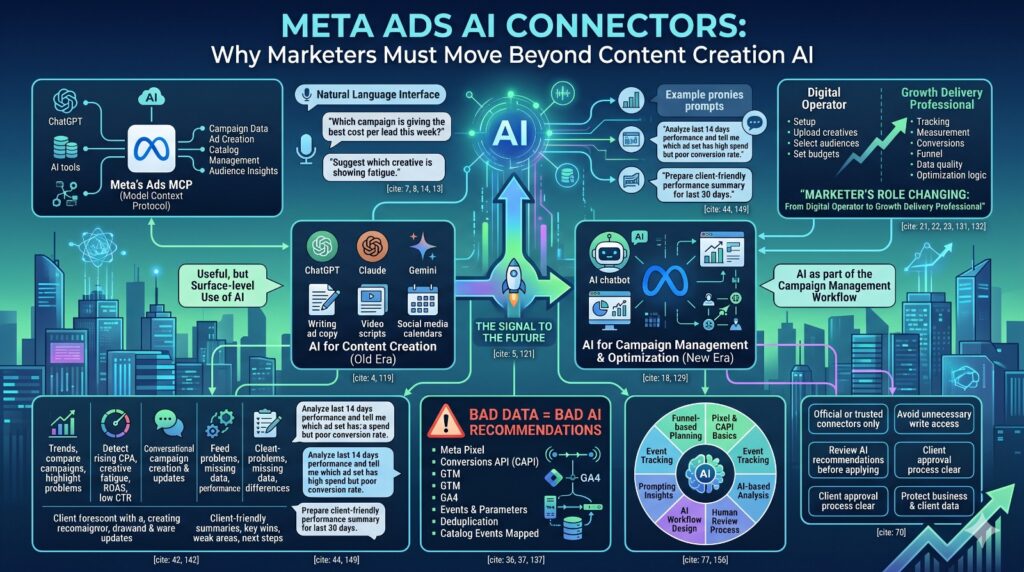
- “Which campaign has the best cost per lead this week?”
- “Where is budget being wasted?”
- “Which creatives are showing fatigue?”
- “Compare performance of two campaigns.”
These connectors work through Meta’s MCP (Model Context Protocol), enabling AI tools to securely access campaign data, reporting, and insights.
Why This Matters
This reduces manual effort and shifts focus toward thinking, analysis, and strategy rather than execution.
The Real Shift: From Execution to Intelligence
Earlier, AI helped before campaigns started—mainly in content creation.
Now, AI works during live campaigns.
Old Marketing Workflow:
- Research
- Create
- Launch
- Analyze
- Optimize
New AI-Driven Workflow:
- Ask
- Analyze instantly
- Decide faster
- Execute smarter
- Iterate continuously
This is a major shift—from manual optimization to intelligent decision systems.
From Digital Operator to Growth-Focused Marketer
This update is redefining the marketer’s role.
A basic marketer focuses on:
- Campaign setup
- Audience selection
- Budget management
A growth-focused marketer focuses on:
- Funnel performance
- Data interpretation
- Conversion tracking
- Strategic optimization
Key Difference:
Basic question:
“Which campaign is best?”
Advanced question:
“Compare campaigns based on CPA, CTR, conversion rate, frequency, and lead quality.”
👉 The depth of your question defines the quality of your results.
Why Tracking Becomes the Most Critical Skill
This is where most marketers struggle.
AI connectors are powerful only when the data is accurate.
If your tracking is weak, AI will make wrong recommendations faster.
Essential Tracking Setup:
- Meta Pixel implementation
- Conversion API (CAPI) integration
- Event tracking (View Content, Add to Cart, Purchase)
- GA4 + GTM setup
- CRM integration for lead quality
- Purchase event not firing
- Incorrect funnel tracking
- No lead quality validation
- Missing event parameters
Common Mistakes:
👉 Bad data = Bad AI decisions
What You Can Actually Do With AI Connectors
Let’s move beyond theory and look at real use cases.
1. Campaign Analysis
AI can quickly summarize performance without manual reporting.
👉 Example:
“Analyze last 14 days and highlight high-spend, low-conversion ad sets.”
2. Optimization Insights
AI can detect issues like:
- Rising CPA
- Falling CTR
- High frequency (creative fatigue)
- Low conversion rates
👉 But remember: AI suggests, marketers decide.
3. Campaign Creation & Updates
Campaign workflows may become more conversational and faster.
👉 This reduces execution time but increases the importance of strategy.
4. Funnel Diagnosis
AI can analyze:
- View Content → Add to Cart → Purchase
👉 And identify where users drop off.
5. Reporting & Client Communication
- Generate client-ready summaries
- Highlight key wins and issues
- Save hours of manual reporting
Prompting: The New Power Skill
Most marketers ignore this—but it’s critical.
Weak Prompt:
“Which campaign is performing best?”
Strong Prompt:
“Compare campaigns based on CPA, CTR, conversion rate, frequency, and lead quality. Identify inefficiencies and suggest optimization.”
👉 Better prompts = Better insights
AI Will Multiply Your Strength (or Weakness)
AI is not magic—it’s a multiplier.
If you don’t understand:
- CPA
- ROAS
- Funnel stages
- Attribution
Then AI output may look impressive but lead to wrong decisions.
Reality:
- Skilled marketer + AI → better results
- Weak marketer + AI → faster mistakes
Risks and Cautions
AI connectors are powerful—but they come with risks.
Key Risks:
- Over-reliance on AI
- Wrong automated decisions
- Data misinterpretation
- Security and access issues
Best Practices:
- Use trusted connectors
- Limit permissions
- Avoid unnecessary write access
- Always review AI suggestions
- Maintain approval processes
👉 AI should support decisions—not replace them
What This Means for Agencies & Teams
This shift will change how teams work.
Traditional Setup:
- Media buyers
- Designers
- Analysts
Future Setup:
- Growth strategists
- Data-focused marketers
- AI workflow specialists
Agencies That Adapt Will:
- Scale faster
- Deliver better insights
- Improve efficiency
- Retain clients longer
What Learners Should Focus On
If you are learning digital marketing, this is your advantage point.
You Must Learn:
1. Core Marketing Fundamentals
- Funnel strategy
- Offer positioning
- Conversion psychology
2. Technical Skills
- Pixel & CAPI
- GA4 & GTM
- Event tracking
3. AI Skills
- Prompting
- Data analysis
- Workflow thinking
👉 The combination of all three = real expertise
Final Thoughts
Meta Ads AI Connectors are not just a feature—they are a signal of where marketing is heading.
The future marketer will:
- Use AI for analysis
- Optimize campaigns faster
- Make smarter decisions
- Focus on growth, not just execution
But success depends on strong fundamentals.
Final Message:
Do not limit AI to content creation.
Use AI for:
- Performance
- Tracking
- Analysis
- Growth
Because in the future, marketers won’t compete on content—
They will compete on who understands data and drives results better.