Introduction
The world of Digital Marketing is experiencing one of its biggest transformations. Businesses are no longer relying only on creativity or traditional campaign management to drive results. Today, success depends on making data-driven decisions, understanding customer behavior, optimizing campaigns in real time, and automating repetitive marketing tasks.
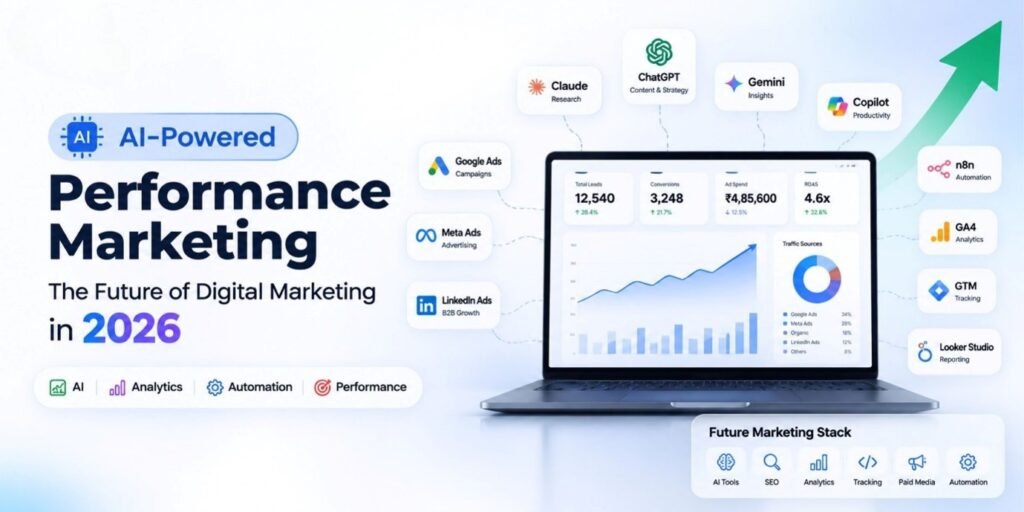
Artificial Intelligence (AI) is at the center of this transformation. Modern marketers are using AI tools like ChatGPT, Claude, Gemini, Microsoft Copilot, Perplexity, n8n, Make, and AI Agents to improve productivity, build better marketing strategies, optimize websites, create high-performing advertising campaigns, and automate reporting.
This new approach is called AI-Powered Performance Marketing—a methodology that combines AI, analytics, tracking, paid media, and automation to deliver measurable business growth.
In this blog, you’ll learn how AI is reshaping digital marketing and why mastering these skills will help you stay competitive in 2026 and beyond.
What is AI-Powered Performance Marketing?
AI-Powered Performance Marketing is the practice of using artificial intelligence to improve every stage of a marketing campaign—from planning and execution to optimization and reporting.
Unlike traditional Digital Marketing, where marketers manually analyze reports and optimize campaigns, AI continuously processes large amounts of data, identifies opportunities, and recommends improvements much faster than manual analysis.
Today’s marketers are not using AI to replace human creativity. Instead, they are using AI to make better decisions and execute marketing tasks more efficiently.
AI-Powered Performance Marketing combines:
- Artificial Intelligence
- Performance Marketing
- Marketing Analytics
- Conversion Tracking
- Website Optimization
- Marketing Automation
- Data-Driven Decision Making
Why Digital Marketing is Changing in 2026
The expectations from digital marketers have changed dramatically over the past few years.
Earlier, marketers mainly focused on creating content and running advertising campaigns. Today, businesses expect professionals to understand the complete marketing ecosystem—from website performance to customer behavior, analytics, automation, and AI-assisted decision-making.
Modern marketers need to work with both creativity and technology.
Today’s marketers should understand:
- AI Productivity
- Marketing Automation
- Customer Journey Analysis
- Conversion Optimization
- Marketing Analytics
- Performance Marketing
- AI-assisted Campaign Management
Professionals who understand these areas are becoming increasingly valuable because they can make faster and more informed marketing decisions.
AI is More Than Just Content Creation
Many people still think AI is mainly used for writing blog posts, social media captions, or marketing emails.
While content generation is an important use case, AI has evolved into a much broader marketing assistant.
Today, marketers use AI to analyze customer behavior, improve landing pages, optimize advertising campaigns, automate reports, generate marketing insights, and improve overall campaign performance.
AI can help marketers with:
- Website Optimization
- SEO Research
- Keyword Clustering
- Audience Analysis
- Campaign Planning
- Marketing Reports
- Data Analysis
- Workflow Automation
Popular AI tools for marketers include:
- ChatGPT
- Claude
- Gemini
- Microsoft Copilot
- Perplexity
- n8n
- Make
- AI Agents
The real value comes from combining these tools with marketing platforms rather than using them independently.
Website Optimization with AI
Your website is often the first interaction customers have with your business.
A well-designed website attracts visitors, but an optimized website converts them into leads and customers.
AI helps marketers identify opportunities that might otherwise be missed during manual reviews.
AI can evaluate:
- Headlines
- Call-to-Action Buttons
- Lead Forms
- Trust Signals
- User Experience
- Mobile Responsiveness
- Content Structure
- Conversion Opportunities
For example, marketers can use ChatGPT to improve landing page messaging, Gemini to review user experience, and GA4 to understand visitor behavior before making optimization decisions.
AI is Transforming SEO
Search engine optimization has become more competitive than ever.
Instead of simply targeting keywords, marketers now need to understand search intent, topical authority, user experience, and content quality.
AI makes this process significantly faster and more accurate.
AI supports SEO by helping with:
- Keyword Research
- Topic Clustering
- Meta Titles
- Meta Descriptions
- Content Outlines
- FAQ Generation
- Internal Linking
- Search Intent Analysis
Many SEO professionals now combine ChatGPT, Claude, Gemini, and Perplexity with Google Search Console and GA4 to build stronger SEO strategies.
AI in Performance Marketing
Performance Marketing focuses on measurable business outcomes rather than impressions or reach alone.
Artificial Intelligence enables marketers to make smarter advertising decisions by analyzing campaign data continuously.
AI improves paid campaigns through:
- Audience Research
- Ad Copy Suggestions
- Creative Testing
- Budget Optimization
- Bid Strategy Recommendations
- Campaign Performance Analysis
- Conversion Forecasting
These improvements benefit campaigns across:
- Google Ads
- Meta Ads
- LinkedIn Ads
Instead of manually testing every variation, marketers can use AI insights to identify winning strategies more efficiently.
Marketing Analytics and Tracking
Great marketing decisions depend on accurate data.
Without proper tracking, even the best advertising campaigns can produce misleading insights.
This is why understanding marketing technology has become essential for modern marketers.
Every performance marketer should understand:
- Google Analytics 4 (GA4)
- Google Tag Manager (GTM)
- HTML
- CSS
- JavaScript
- JSON
- DataLayer
You don’t need to become a developer, but understanding how these technologies work together helps marketers troubleshoot tracking issues, measure campaign performance, and improve marketing decisions.
Marketing Automation with AI
Marketing teams spend a significant amount of time on repetitive tasks.
Automation platforms eliminate much of this manual work by connecting marketing tools together.
Platforms like n8n, Make, and AI Agents allow marketers to automate complete workflows.
Example workflow:
- Customer submits a lead form.
- n8n captures the lead automatically.
- ChatGPT generates a personalized follow-up email.
- CRM is updated instantly.
- Google Sheets records the lead.
- Slack notifies the sales team.
- GA4 updates conversion data.
- Dashboard reports refresh automatically.
This creates a faster, more efficient marketing operation while reducing manual effort.
Skills Every Future Performance Marketer Needs
The future belongs to marketers who combine AI with technical marketing knowledge.
Instead of mastering a single platform, professionals should build a complete marketing skill set.
Essential skills include:
AI Productivity
- ChatGPT
- Claude
- Gemini
- Microsoft Copilot
Marketing Analytics
- Google Analytics 4
- Looker Studio
Tracking
- Google Tag Manager
- DataLayer
Paid Advertising
- Google Ads
- Meta Ads
- LinkedIn Ads
Marketing Automation
- n8n
- Make
- AI Agents
Learning these skills prepares marketers for the growing demand for AI-powered marketing professionals.
Why Businesses Prefer AI-Powered Marketers
Businesses today are looking for professionals who can deliver measurable business outcomes rather than simply manage campaigns.
AI-powered marketers bring together creativity, data analysis, and automation to improve efficiency and performance.
They help businesses:
- Increase marketing ROI
- Reduce manual work
- Improve campaign optimization
- Make data-driven decisions
- Automate repetitive tasks
- Scale marketing operations
- Generate better customer insights
These capabilities make AI-powered marketers valuable across startups, agencies, and enterprise organizations.
Key Takeaways
- AI is transforming every area of Digital Marketing.
- AI supports strategy—it doesn’t replace marketers.
- Performance Marketing depends on analytics, tracking, and optimization.
- Website optimization, SEO, paid media, and automation work best when powered by AI.
- Tools like ChatGPT, Claude, Gemini, Microsoft Copilot, Perplexity, n8n, Make, AI Agents, GA4, and GTM help marketers improve productivity and campaign performance.
- The marketers who combine AI with marketing strategy will have a strong competitive advantage in the coming years.
Frequently Asked Questions
Is AI replacing Digital Marketers?
No. AI automates repetitive tasks and provides insights, while marketers focus on strategy, creativity, customer experience, and business growth.
Which AI tools should digital marketers learn first?
A practical starting point includes:
- ChatGPT
- Gemini
- Claude
- Microsoft Copilot
- Perplexity
As your skills grow, add:
- n8n
- Make
- AI Agents
- GA4
- GTM
Why should marketers learn Google Analytics 4 and Google Tag Manager?
GA4 and GTM provide accurate tracking, analytics, and measurement, helping marketers understand customer behavior and optimize campaigns more effectively.
Can AI improve Google Ads and Meta Ads performance?
Yes. AI can assist with keyword research, audience targeting, bid optimization, creative testing, campaign analysis, reporting, and ongoing optimization to improve advertising performance.
Final Thoughts
The future of Digital Marketing belongs to professionals who can combine AI, analytics, tracking, automation, and performance marketing into a single strategy.
Learning to use ChatGPT, Claude, Gemini, Microsoft Copilot, Perplexity, n8n, Make, AI Agents, GA4, GTM, Google Ads, Meta Ads, Looker Studio, and other AI-powered marketing technologies will help marketers work smarter, optimize campaigns faster, and deliver measurable business results.
AI-Powered Performance Marketing is no longer just an emerging trend—it is becoming the new standard for successful digital marketers. Professionals who invest in these skills today will be better prepared for the evolving demands of the marketing industry tomorrow.