Introduction
Digital marketing is no longer just about learning Google Ads, Meta Ads, SEO, social media or analytics.
AI has become part of the daily marketing workflow.
Marketers now use AI to research audiences, analyse campaign data, create content, develop ad variations, summarise reports, build strategies and automate repetitive tasks.
But this creates a new problem.
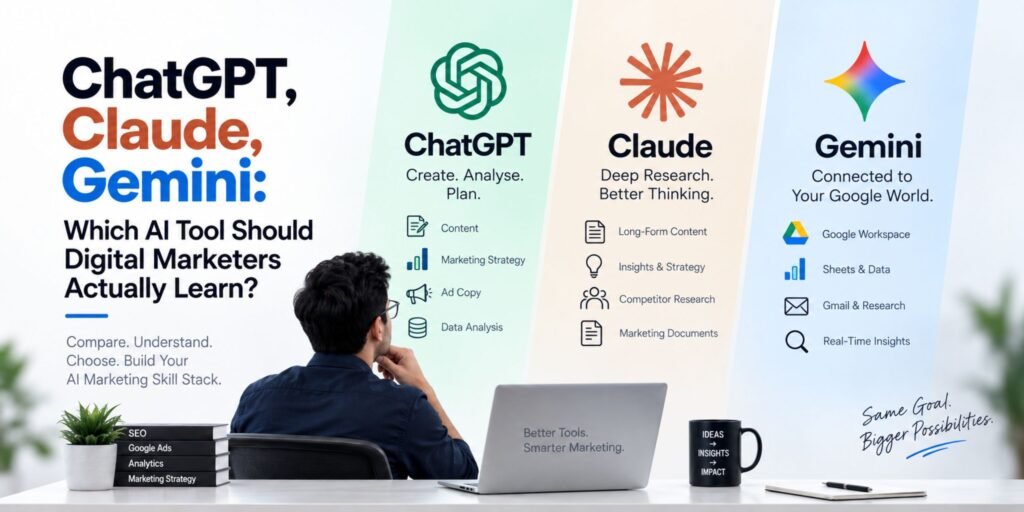
Which AI tool should a digital marketer actually learn?
Should you start with ChatGPT?
Would Claude be better for strategy and long-form work?
Should you learn Gemini because so much marketing data already lives inside Google’s ecosystem?
The answer is not as simple as choosing one winner.
These tools increasingly overlap. Their capabilities also change quickly, so comparing them only by model benchmarks or asking which one is “smartest” can lead marketers in the wrong direction.
The better question is:
Which AI tool fits the marketing work you need to perform?
For most marketers, the goal should not be to become an expert in every AI platform. The goal should be to build a practical AI-powered marketing skill stack where AI helps with research, content, advertising, analytics, reporting and automation—while the marketer remains responsible for strategy and decisions.
Why Marketers Don’t Need to Learn Every AI Tool
The biggest mistake is AI tool collecting.
A marketer discovers:
- ChatGPT
- Claude
- Gemini
- Perplexity
- Canva AI
- AI image generators
- AI video tools
- AI SEO platforms
- n8n
- Make
- AI agents
Then spends weeks learning interfaces instead of improving marketing skills.
Knowing 20 AI tools does not automatically make someone a better marketer.
A better approach is:
Marketing problem → Right AI tool → Marketing workflow → Measurable outcome
For example:
Campaign data
↓
AI analysis
↓
Identify weak campaigns
↓
Investigate conversion quality
↓
Optimise budget
↓
Measure the result
That is much more valuable than simply knowing how to generate an attractive paragraph with an AI chatbot.
ChatGPT for Digital Marketers
ChatGPT is a strong starting point for marketers because it can support a wide range of marketing activities.
OpenAI’s current marketing guidance highlights use cases including writing, deep research, brainstorming and data analysis. It specifically describes workflows such as drafting landing pages and ads, researching competitors and audience insights, planning content calendars, reviewing campaign performance and interpreting A/B-test results.
1. Content Marketing
ChatGPT can help marketers move from a blank page to a structured first draft.
For example, a marketer can use it to develop:
- Blog outlines
- Social media posts
- Email campaigns
- Landing-page copy
- Ad variations
- Video scripts
- Content calendars
- Content repurposing plans
But the best results don’t come from:
“Write a blog about digital marketing.”
A stronger workflow is:
“Create a 1,500-word article for performance marketers explaining how GA4 helps evaluate campaign quality. Include practical examples, common mistakes, and a section on AI-assisted analysis.”
Then the marketer reviews and improves the output.
AI creates the first version.
Marketing expertise creates the final version.
2. ChatGPT for Performance Marketing
Performance marketers can use ChatGPT for more than writing ad copy.
It can help analyse campaign exports and turn raw numbers into questions and potential actions.
For example, you could upload campaign data containing:
| Campaign | Spend | Clicks | Leads | CPA | ROAS |
| Campaign A | ₹50,000 | 4,500 | 120 | ₹417 | 3.8x |
| Campaign B | ₹45,000 | 5,200 | 70 | ₹643 | 2.1x |
| Campaign C | ₹30,000 | 2,100 | 95 | ₹316 | 4.4x |
Instead of manually scanning the spreadsheet, you can ask:
“Identify campaigns with high spend and weak efficiency. Then compare CPA and ROAS and suggest what should be investigated first.”
OpenAI’s current data-analysis guidance says ChatGPT can work with uploaded CSV and Excel files, help clean and explore data, create visualisations and turn datasets into insights and recommended actions.
However, there is an important limitation:
AI should not automatically become the decision-maker.
A low CPA does not necessarily mean a campaign is better.
You may also need to consider:
- Lead quality
- Sales conversion rate
- Revenue
- Customer lifetime value
- Profit margin
- Attribution
- Tracking accuracy
This is where marketing knowledge remains essential.
3. ChatGPT for Research
Research is another valuable use case.
Instead of asking:
“What are the latest digital marketing trends?”
A marketer can create a specific research task:
“Research the current challenges faced by small B2B businesses running Google Ads. Identify common acquisition problems, reporting problems and lead-quality issues, and provide sources.”
ChatGPT’s Deep Research can conduct multi-step online research and produce structured reports with citations or source links.
This can be useful for:
- Competitor research
- Audience research
- Market analysis
- Content research
- Industry research
- Campaign planning
Again, the marketer should verify important claims before using them in client-facing work.
Claude for Digital Marketers
Claude is another powerful option, particularly for marketers working with substantial amounts of information and complex professional tasks.
Anthropic’s current documentation describes Claude models as capable of tasks including research, financial analysis, and working with documents, spreadsheets and presentations.
Anthropic’s 2026 usage research also found that documents and reports are among the most common artifact types produced in Claude conversations.
That makes Claude particularly interesting for workflows where the marketer needs to read, structure, analyse and transform information.
4. Claude for Long-Form Marketing Work
Imagine you have:
- A 40-page market research report
- Customer interview notes
- Competitor information
- Brand guidelines
- Existing campaign data
Instead of immediately asking for social posts, you could ask Claude to first identify:
Audience problems → Market gaps → Positioning opportunities → Content themes
Then turn those findings into a marketing strategy.
This is a more mature AI workflow.
The AI is not simply generating content.
It is helping organise information before content is created.
Claude’s current models also support substantial context and professional tasks involving documents, spreadsheets and presentations.
5. Claude for Strategy and Documentation
Claude can also be useful for building structured marketing documents such as:
- Campaign briefs
- Brand messaging frameworks
- Customer personas
- Competitor analysis
- Content strategies
- Marketing plans
- Research summaries
- Internal documentation
For example:
Input: Customer interviews + sales objections + competitor positioning
↓
Claude: Identify recurring customer problems
↓
Marketing team: Build positioning
↓
Content team: Create messaging
↓
Performance team: Turn messaging into ads and landing pages
The important point is that AI is supporting the workflow rather than replacing the marketing team.
Gemini for Digital Marketers
Gemini becomes particularly valuable when a marketer already works heavily inside the Google ecosystem.
Google has expanded Gemini across Docs, Sheets, Slides and Drive, allowing users to create and analyse content using information stored across their Workspace environment.
This creates an important advantage for marketers:
Context can stay close to the work.
6. Gemini for Google Workspace
Consider a campaign manager preparing a monthly client report.
The information may be spread across:
Gmail
Client communication
Google Drive
Campaign documents
Google Sheets
Performance data
Google Docs
Strategy notes
Google Slides
Client presentation
Gemini can help connect these types of workflows within Google’s ecosystem.
Google says Gemini in Workspace can work with documents, spreadsheets, presentations, emails and files, while newer features can help create and analyse spreadsheets and retrieve information from Workspace sources.
For marketers already using Google Workspace every day, that integration can be more important than simply comparing chatbot responses.
7. Gemini for Marketing Data
Google has also continued expanding Gemini’s capabilities in Sheets.
In 2026, Google announced improvements that allow Gemini in Sheets to create, organise and edit spreadsheets and assist with complex data-analysis tasks.
For a marketer, this could mean workflows such as:
Campaign export
↓
Google Sheets
↓
Gemini-assisted analysis
↓
Identify trends / anomalies
↓
Create management summary
That can reduce repetitive spreadsheet work.
But again:
AI analysis is not the same as marketing judgment.
ChatGPT vs Claude vs Gemini: Which Should You Learn?
There is no permanent winner.
Instead, think about the type of work you perform.
| Your Primary Need | Strong Starting Choice |
| General marketing AI | ChatGPT |
| Content and campaign ideation | ChatGPT / Claude |
| Data analysis | ChatGPT / Gemini |
| Long documents & complex knowledge work | Claude |
| Google Workspace workflows | Gemini |
| Google Sheets workflows | Gemini |
| Research | ChatGPT / Claude / Gemini |
| Marketing strategy | ChatGPT / Claude |
| Reporting workflows | ChatGPT / Gemini |
| AI-powered automation | ChatGPT / Claude + n8n/Make |
This is a workflow recommendation, not a permanent ranking. AI products change quickly, and the best choice can depend on your plan, integrations, data environment and the specific task.
So, Which One Should a Beginner Learn First?
For most digital marketers, I would recommend starting with ChatGPT.
Why?
Because it gives you a broad environment for learning AI-assisted:
- Research
- Content
- Campaign planning
- Data analysis
- Reporting
- Brainstorming
- Strategy
- Workflow design
Once you understand these workflows, learning another AI platform becomes much easier.
You are no longer learning:
“How does this chatbot work?”
You’re learning:
“How can AI improve this marketing process?”
That’s a much more valuable skill.
But Experienced Marketers Should Learn More Than One
Once you’re comfortable with one platform, add another based on your workflow.
Example:
ChatGPT
For campaign strategy and analysis
↓
Claude
For deeper documents and structured research
↓
Gemini
For Google Workspace and Sheets
↓
n8n / Make
For automation
↓
GA4 + GTM + CRM
For measurement and customer data
↓
Human marketer
For decisions
This is the beginning of an actual AI marketing stack.
AI Tools Should Connect to Your Existing Marketing Skills
This is where the conversation becomes more important.
A marketer should not learn AI separately from marketing.
Instead, connect AI to existing skills.
SEO
Use AI to help with:
- Keyword clustering
- Search-intent analysis
- Content briefs
- Internal-link planning
- Competitor research
- Content optimisation
But verify search intent and factual accuracy yourself.
Google Ads
AI can assist with:
- Campaign structure
- Keyword grouping
- Ad-copy variations
- Search-term analysis
- Performance summaries
- Testing ideas
But the marketer still needs to understand:
- Bidding
- Attribution
- Conversion tracking
- Budget allocation
- Search intent
- Profitability
Meta Ads
AI can help generate:
- Creative concepts
- Hooks
- Primary text
- Headlines
- Testing matrices
- Audience hypotheses
But you still need to understand:
Creative testing + audience quality + attribution + conversion quality.
GA4 and GTM
AI can help explain:
- Events
- Parameters
- Conversion data
- Reporting trends
- Tracking anomalies
But AI cannot magically fix a badly implemented tracking system.
If the underlying data is wrong:
Better AI analysis simply produces better-looking conclusions from bad data.
Add Automation to the AI Skill Stack
Learning ChatGPT, Claude or Gemini is only one layer.
The next layer is automation.
Tools such as n8n and Make can connect AI models with marketing workflows.
For example:
Lead Analysis Workflow
Website Lead Form
↓
CRM
↓
AI Lead Classification
↓
High / Medium / Low Intent
↓
Sales Notification
↓
Follow-up
Another example:
Weekly Reporting Workflow
Google Ads + Meta Ads + GA4
↓
Data Collection
↓
AI Analysis
↓
Performance Summary
↓
Management Report
This is where AI starts becoming operational rather than simply conversational.
The Real Skill Is Not Prompting
Prompting matters.
But prompting alone is not enough.
A marketer can write a perfect prompt and still produce a poor marketing outcome if the underlying strategy is weak.
The stronger skill stack is:
1. Marketing Fundamentals
Understand:
- Audience
- Offer
- Positioning
- Funnel
- Customer journey
2. Platform Skills
Understand:
- Google Ads
- Meta Ads
- SEO
- Social media
- Analytics
3. Measurement
Understand:
- GTM
- GA4
- Conversion tracking
- Attribution
- Reporting
4. AI
Understand:
- ChatGPT
- Claude
- Gemini
- AI research
- AI analysis
- AI content workflows
5. Automation
Understand:
- n8n
- Make
- APIs
- Webhooks
- AI Agents
6. Business Judgment
Understand:
What should we do next—and why?
That final skill is difficult to automate because it requires business context, risk assessment and accountability.
A Practical 30-Day AI Learning Plan for Digital Marketers
Instead of trying to master every AI platform simultaneously, use a structured approach.
Week 1: ChatGPT
Build practical workflows for:
- Content planning
- Ad copy
- SEO research
- Campaign analysis
- Reporting
Don’t collect prompts.
Build reusable workflows.
Week 2: Claude
Use it for:
- Long-form documents
- Competitor research
- Strategy
- Marketing briefs
- Structured analysis
Compare the workflow—not just the answers.
Week 3: Gemini
Connect your learning to:
- Google Sheets
- Google Docs
- Gmail
- Google Drive
- Google Search
Build a simple reporting or research workflow.
Week 4: Automation
Use:
- n8n
- Make
- AI tools
- Google Sheets
- CRM
Build one useful automation.
For example:
Lead → AI classification → CRM → sales notification
At the end of 30 days, you should have something more valuable than a list of AI tools:
a working AI marketing system.
The Biggest Mistake Marketers Should Avoid
Don’t use AI just because everyone else is using it.
Ask:
Before AI:
What problem am I solving?
With AI:
Can AI make this faster, better or more scalable?
After AI:
Did the business outcome improve?
For example:
Generating 100 ad headlines isn’t automatically useful.
If none of them improves CTR, conversion rate or lead quality, the productivity gain may not matter.
Similarly, producing a 2,000-word blog in 30 seconds is not necessarily a success.
If it doesn’t attract qualified traffic or support business goals, speed alone has little value.
AI Should Improve Marketing Outcomes, Not Just Marketing Activity
This is the distinction marketers need to understand.
Activity Metrics
- More content
- More ads
- More reports
- More emails
- More ideas
versus
Business Outcomes
- Better leads
- Lower acquisition cost
- Higher conversion rate
- Better ROAS
- Higher revenue
- Faster reporting
- Better customer retention
AI should ultimately move the second group.
Final Verdict
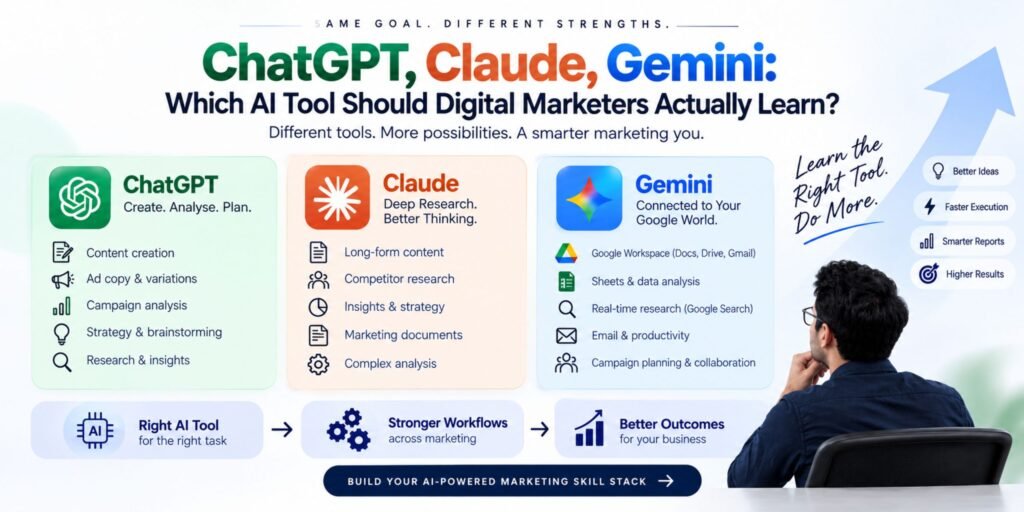
So, ChatGPT vs Claude vs Gemini—what should digital marketers actually learn?
Start with ChatGPT if you want:
A broad AI marketing workbench.
Add Claude if you need:
Deep document work, research and complex knowledge workflows.
Learn Gemini if you work heavily with:
Google Search, Sheets, Docs, Gmail and Drive.
But don’t stop at the AI interface.
The strongest digital marketer in 2026 is not necessarily the person who knows the most AI tools.
It is the person who can connect:
AI + Marketing Strategy + Data + Tracking + Automation + Business Judgment
That’s the real skill stack.
AI can help you write the ad.
It can help analyse the campaign.
It can summarise the report.
It can automate the workflow.
But you still need to know what the business should do next.
Don’t become an AI-tool collector. Become an AI-powered marketer.
Frequently Asked Questions
Which is better for digital marketing: ChatGPT, Claude or Gemini?
There is no universal winner. ChatGPT is a strong general-purpose starting point, Claude is valuable for complex knowledge work and substantial documents, while Gemini is particularly useful for marketers working deeply within Google’s ecosystem.
Should a digital marketer learn all three?
Eventually, understanding all three can be useful. However, beginners should master one workflow first instead of trying to learn every AI platform simultaneously.
Is ChatGPT enough for digital marketing?
ChatGPT can support a large range of marketing workflows, but it should not replace knowledge of SEO, Google Ads, Meta Ads, GTM, GA4, CRM systems or business strategy.
Is Gemini useful for Google Ads marketers?
Yes, particularly when the marketer’s broader workflow uses Google Workspace, Sheets, Drive and other Google products. Gemini’s Workspace capabilities can help with research, documents and spreadsheet workflows.
Can Claude analyse marketing data?
Claude’s current models support professional tasks including analysis and work with spreadsheets and documents.
Will AI replace digital marketers?
AI will automate many repetitive marketing tasks, but marketers still need to understand strategy, measurement, customer behaviour, profitability and business context. The competitive advantage is increasingly knowing how to use AI while retaining strong marketing judgment.
Conclusion
The question isn’t really:
“ChatGPT, Claude or Gemini—which one wins?”
The better question is:
“Which AI workflow can help me become a better marketer?”
Start with one platform. Build real workflows. Connect AI to SEO, paid media, analytics, tracking and automation. Then expand your toolkit based on the problems you actually need to solve.
Because the future of digital marketing isn’t about AI versus marketers.
It’s about marketers who know how to work with AI versus marketers who don’t.