Introduction
For more than two decades, Search Engine Optimization (SEO) was largely about winning visibility in Google’s traditional search results. Marketers focused on keywords, backlinks, technical SEO, rankings, and click-through rates to bring users from search results to their websites.
That model is changing.
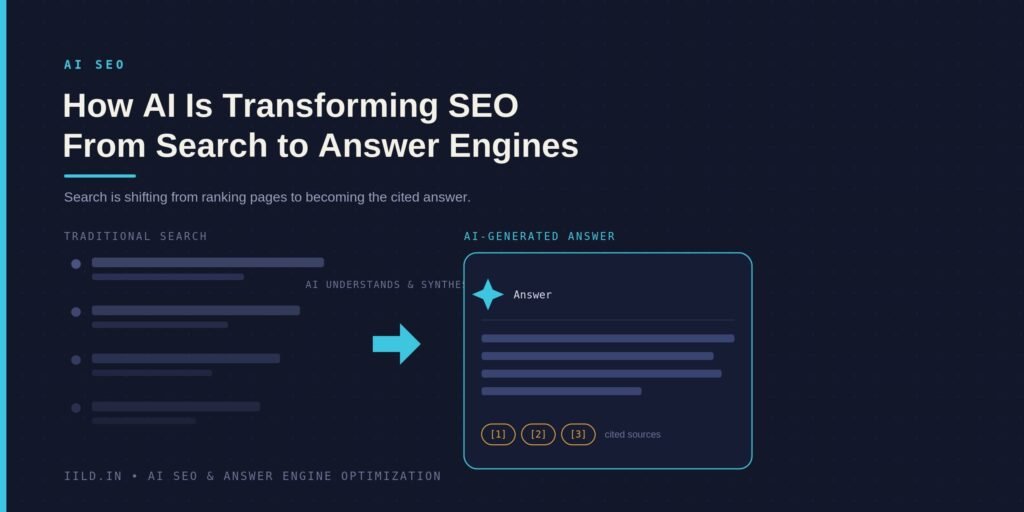
The growth of AI-powered search experiences such as Google AI Overviews, ChatGPT Search, Microsoft Copilot, Gemini, and Perplexity is changing how people discover and consume information. Instead of simply displaying a list of web pages, AI-powered systems can understand a query, combine information from multiple sources, and generate a direct answer.
This creates a new layer of search visibility.
SEO is no longer only about ranking a webpage. Increasingly, marketers also need to make their content useful, trustworthy, structured, and understandable enough to be selected, cited, or referenced in AI-generated answers.
This evolution has led to growing interest in Answer Engine Optimization (AEO) and related approaches such as Generative Engine Optimization (GEO).
The important point is that AEO does not replace SEO. Instead, it expands what successful SEO needs to accomplish.
From Ten Blue Links to AI-Generated Answers
Traditional search follows a relatively straightforward journey:
Search Query → Search Results → Website → Answer
A user enters a keyword, reviews the results, clicks a page, and finds the information they need.
AI-powered search can shorten that journey:
Search Query → AI Understanding → Synthesized Answer → Sources
For example, instead of searching for several separate articles about a marketing strategy, a user might ask an AI search system to explain the best strategy for their specific business situation.
The system can then summarize information from multiple sources and provide references to the websites it considers useful.
Examples of AI-powered search experiences include:
- Google AI Overviews — AI-generated summaries integrated into Google Search.
- ChatGPT Search — conversational search that can provide answers with web-based sources.
- Perplexity — an answer-focused search experience built around sourced responses.
- Gemini — Google’s AI ecosystem for conversational research and information discovery.
- Microsoft Copilot — AI assistance integrated across Microsoft’s search and productivity ecosystem.
This means a business can potentially receive visibility even when a user does not interact with a traditional blue-link result.
The key question is changing from:
“How do I rank #1?”
to:
“How do I become a trusted source for the answer?”
Why AI Search Matters for Marketers
The shift toward answer engines creates several important changes in digital marketing.
1. Clicks Are No Longer the Only Visibility Signal
When an AI system provides a useful answer directly in the search experience, the user may not need to click through to every source.
This can create more zero-click behavior, particularly for informational searches.
However, fewer clicks do not automatically mean less value.
A brand that is repeatedly mentioned or cited by AI systems can build visibility, authority, and familiarity before the user ever visits its website.
For marketers, this means organic performance needs to be evaluated beyond rankings and sessions.
2. Content Must Be Easy to Understand and Extract
AI systems need to interpret large amounts of information quickly.
Poorly structured content makes that harder.
Content becomes more useful when it contains:
- Clear headings
- Short paragraphs
- Direct answers
- Bullet points
- Numbered steps
- Tables
- Definitions
- FAQs
- Supporting examples
- Relevant statistics
- Proper contextual links
Instead of writing primarily for keyword density, marketers should focus on clarity, usefulness, context, and search intent.
What Is Answer Engine Optimization?
Answer Engine Optimization (AEO) is the practice of creating and structuring content so that it can effectively answer user questions and increase its chances of being surfaced, cited, or referenced by answer-focused search experiences.
Traditional SEO asks:
How can this page rank for the target query?
AEO asks:
How can this content provide the clearest and most trustworthy answer to the user’s question?
The two approaches overlap heavily.
A strong AEO strategy still depends on many traditional SEO fundamentals, including:
- Technical SEO
- Crawlability
- Indexability
- Quality content
- Internal linking
- Website performance
- Authority
- Backlinks
- Search intent
AEO simply adds another layer of optimization.
7 Ways AI Is Changing SEO
1. Answer-First Content Is Becoming More Important
One of the simplest improvements marketers can make is to provide the answer earlier.
Avoid forcing readers through a long introduction before answering the question.
For example, if the question is:
“What is Google Tag Manager?”
Start with a concise definition:
Google Tag Manager is a tag management system that allows marketers to deploy and manage tracking and marketing tags without repeatedly editing website code.
Then provide the deeper explanation.
This structure benefits both users and AI systems because the core information is immediately clear.
Practical approach:
Question → Direct Answer → Explanation → Example → Supporting Evidence
2. Search Intent Matters More Than Individual Keywords
Traditional SEO often started with keyword research.
Modern SEO needs to go further.
A single keyword can represent multiple intentions.
For example, someone searching for:
“GA4”
could want:
- A definition
- A setup guide
- Training
- Reporting help
- Troubleshooting
- Analytics services
AI tools such as ChatGPT, Gemini, Claude, and Perplexity can help marketers analyze large keyword lists and classify them by:
- Search intent
- Topic
- Funnel stage
- Audience
- Question type
- Page type
This allows marketers to build content around user needs rather than isolated keywords.
3. Structured Content Gives AI More Context
AI systems need context to understand what a page is about.
Clear content structure helps provide that context.
For example:
Main Topic
AI-Powered SEO
Supporting Topics
- Keyword research
- Search intent
- Content optimization
- Technical SEO
- Search Console
- Content refresh
Common Questions
- What is AI SEO?
- How can AI help with keyword research?
- Can AI improve SEO content?
- How does AI affect Google rankings?
This creates a logical information architecture that is easier for both humans and machines to understand.
4. E-E-A-T Becomes Even More Important
AI-generated information is abundant.
That makes trustworthy information more valuable.
Google’s E-E-A-T framework—Experience, Expertise, Authoritativeness, and Trustworthiness—remains important when building credible content.
Marketers should strengthen credibility through:
- Real author profiles
- Relevant professional experience
- Original research
- First-hand examples
- Reliable citations
- Case studies
- Transparent methodology
- Accurate information
- Updated content
For example, a digital marketing article written by someone who has actually implemented GA4, Google Tag Manager, Google Ads, Meta Ads, SEO, and marketing automation can provide more practical value than generic AI-generated content.
AI can accelerate content creation, but human expertise is what gives the content credibility.
5. Schema Markup and Structured Data Still Matter
Structured data helps search engines understand the entities, relationships, and purpose of information on a webpage.
Depending on the content, marketers may use appropriate structured data such as:
- Article
- Organization
- Person
- Product
- Course
- Event
- Breadcrumb
Schema markup should not be treated as a guarantee of AI visibility.
Instead, think of it as part of a broader technical strategy that makes your website easier for search systems to interpret.
6. Original Data Can Become a Competitive Advantage
AI can easily generate generic explanations.
That creates a problem for websites publishing the same information as everyone else.
Original information becomes more valuable.
Consider creating:
- Industry surveys
- First-party research
- Campaign benchmarks
- Case studies
- Original statistics
- Marketing experiments
- Conversion data
- Expert interviews
- Proprietary frameworks
For example, instead of publishing another generic article about paid advertising, a marketing company could publish:
“What We Learned From Managing 100 Lead Generation Campaigns.”
That type of content provides information that cannot simply be copied from dozens of existing articles.
7. Conversational Search Changes Keyword Strategy
People don’t always communicate with AI systems using short keywords.
They ask complete questions.
Instead of:
“SEO course Delhi”
a user might ask:
“Which SEO skills should a beginner learn to get a digital marketing job in 2026?”
This creates opportunities for content targeting natural-language questions.
Marketers should therefore build content around:
- Who
- What
- Why
- How
- When
- Which
- Best practices
- Comparisons
- Problems
- Use cases
AI tools such as ChatGPT, Gemini, Claude, and Perplexity can help generate question variations, but marketers should validate those questions against actual audience needs and search data.
Traditional SEO vs. AEO
| Element | Traditional SEO | AEO |
| Primary Goal | Rank in search results | Become a useful answer source |
| Core Focus | Keywords | Questions and intent |
| Content | Keyword-focused | Answer-first and structured |
| Visibility | Rankings and traffic | Citations, mentions and AI visibility |
| Technical Focus | Crawlability, speed, links | Crawlability, structure and context |
| Trust | Authority and backlinks | Expertise, evidence and original insight |
| Optimization | Search engines | Search and answer experiences |
The distinction is useful, but marketers should avoid treating SEO and AEO as completely separate disciplines.
AEO is better understood as an extension of modern SEO.
How AI Tools Can Support an AEO Strategy
AI tools can make the SEO workflow faster, but they should support strategy rather than replace it.
ChatGPT
Use ChatGPT for:
- Search-intent analysis
- Content outlines
- FAQ discovery
- Content gap analysis
- Title variations
- Meta descriptions
- Content refresh ideas
Gemini
Gemini can support:
- Topic research
- Content planning
- Search-question exploration
- Information organization
- Content ideation
Claude
Claude can be useful for:
- Long-form content analysis
- Content restructuring
- Editorial review
- Comparing multiple content drafts
Perplexity
Perplexity can help marketers explore:
- Research questions
- Industry information
- Source discovery
- Competitive topics
However, important facts should still be verified against reliable primary sources.
n8n
n8n can take AI-assisted SEO beyond individual prompts by connecting workflows.
For example:
Keyword Data → AI Classification → Content Brief → Human Review → WordPress Draft → Search Console Data → Content Refresh
This is where AI becomes part of a repeatable marketing system, rather than simply a writing assistant.
Practical AEO Strategy for Your Website
If you want to adapt an existing SEO strategy for AI-powered search, start with your current content.
Step 1: Identify Your Most Valuable Pages
Review:
- High-traffic pages
- High-impression pages
- Conversion pages
- Service pages
- Product pages
- Existing ranking pages
Don’t immediately create hundreds of new articles.
First improve the content you already have.
Step 2: Find Question Opportunities
Use Google Search Console, keyword research tools, customer questions, sales conversations, and AI tools to identify questions around your topics.
Group them by:
Topic → Intent → Funnel Stage → Page Type
Step 3: Add Direct Answers
For important questions, provide concise answers near the beginning of the relevant section.
Then expand with evidence, examples, and practical guidance.
Step 4: Improve Content Structure
Use:
- H2 and H3 headings
- Bullet points
- Tables
- Step-by-step instructions
- Definitions
- FAQs
- Examples
- Relevant internal links
Make the content easy to scan.
Step 5: Strengthen Trust
Add:
- Author information
- Credentials
- Experience
- Sources
- Original examples
- Case studies
- Updated dates where appropriate
Don’t let AI-generated content become anonymous and generic.
Step 6: Add Relevant Structured Data
Implement appropriate schema markup and make sure your website is technically accessible to search crawlers.
Step 7: Monitor AI Visibility
Traditional SEO tools remain important, but add an AI visibility layer.
Periodically test relevant questions across:
- Google AI search experiences
- ChatGPT
- Perplexity
- Gemini
- Copilot
Track whether your:
- Brand is mentioned
- Website is cited
- Content is referenced
- Competitors appear instead
- Key pages are being surfaced
AI visibility is still harder to measure consistently than traditional rankings, so treat these observations as an additional qualitative signal rather than a replacement for Search Console and analytics data.
Don’t Make the Mistake of Abandoning Traditional SEO
There is a common misconception that AI search means traditional SEO is finished.
That’s the wrong conclusion.
AI systems still depend heavily on the web’s underlying information ecosystem.
A website still needs to be:
- Crawlable
- Indexable
- Fast
- Mobile-friendly
- Technically sound
- Well structured
- Relevant
- Authoritative
- Useful
Backlinks, internal linking, content quality, technical SEO, and search intent don’t suddenly become irrelevant because AI is generating answers.
The better strategy is:
SEO Foundation + AEO + Original Expertise + AI-Assisted Workflows
The Future of SEO Is Not Search vs. AI
The future is not about choosing between traditional search optimization and AI optimization.
It is about understanding how users discover information across multiple interfaces.
Today, someone may discover a brand through:
Google Search → AI Overview → ChatGPT → Perplexity → YouTube → Social Media → Website
The search journey is becoming fragmented.
That means marketers need to think about visibility across the entire discovery ecosystem, not just one ranking page.
The New SEO Workflow
A modern AI-powered SEO workflow can look like this:
Keyword Research
↓
Search Intent Analysis
↓
Topic Clustering
↓
AI-Assisted Content Brief
↓
Expert Content Creation
↓
SEO + AEO Optimization
↓
Human Review
↓
Publish
↓
Search Console & Analytics Monitoring
↓
Content Refresh
AI tools such as ChatGPT, Gemini, Claude, Perplexity, and n8n can accelerate different parts of this process.
But the marketer remains responsible for strategy, validation, brand positioning, accuracy, and business outcomes.
Final Thoughts
SEO is not disappearing.
The definition of search visibility is expanding.
For years, the primary objective was to get a webpage onto the first page of Google. Now, marketers also need to consider whether their content can become part of the answers generated by AI-powered search experiences.
That requires more than adding keywords.
It requires content that is:
- Direct
- Well structured
- Helpful
- Credible
- Original
- Technically accessible
- Aligned with search intent
The strongest strategy is not to abandon traditional SEO for AEO.
It is to build on the SEO fundamentals that already work while adapting content for a world where users increasingly ask questions instead of simply searching keywords.
The marketers who understand this shift—and combine SEO knowledge with AI tools, analytics, tracking, content strategy, and automation—will be better positioned for the next phase of search.The future of SEO isn’t just about ranking for the answer. It’s about becoming part of the answer.